
Core idea
Zero net force preserves velocity
Newton’s First Law says that an object keeps a constant velocity when the vector sum of external forces is zero. Rest is one possible constant velocity, but an object can also coast in a straight line at a nonzero speed. A force is required to change velocity, not to keep an existing velocity going.
Equilibrium is therefore a statement about acceleration. With a chosen coordinate system, ΣF = 0 means a = 0, so velocity stays constant. In two dimensions, both component sums must be zero: ΣFx = 0 and ΣFy = 0.
Static equilibrium
The object is at rest and remains at rest because the net force is zero.
Dynamic equilibrium
The object is moving at constant velocity and remains moving because the net force is still zero.
Guided lesson path
Build equilibrium from motion evidence
- Observe rest with zero net force. A block on a frictionless surface stays at rest while its velocity and acceleration remain zero.
- Choose your own velocity. Give the block any horizontal velocity from 1.0 to 4.0 m/s while keeping horizontal forces at zero. The velocity graph remains horizontal at the value you selected.
- Test the common misconception. A moving block continues without a forward applied force. A nonzero net force is needed to change its velocity.
- Add and balance forces. A +6 N force and a −6 N force can both be present while the block continues at constant velocity. The number of forces is not the same as the net force.
- Compare no-force and balanced-force systems. A block with no horizontal forces and one with equal opposing forces can have the same constant motion because both have zero net force.
- Check static equilibrium. On a level floor, upward normal force balances downward weight. A 5 kg crate has normal force 49 N when there is no vertical acceleration.
- Break the balance. With 10 N applied force and 10 N friction, velocity stays constant. Increase the applied force and the horizontal net force becomes nonzero, so the velocity changes.
- Connect inertia to mass. A 2 kg and a 6 kg block receiving the same 12 N net force have different accelerations. The larger mass has greater resistance to a change in velocity.
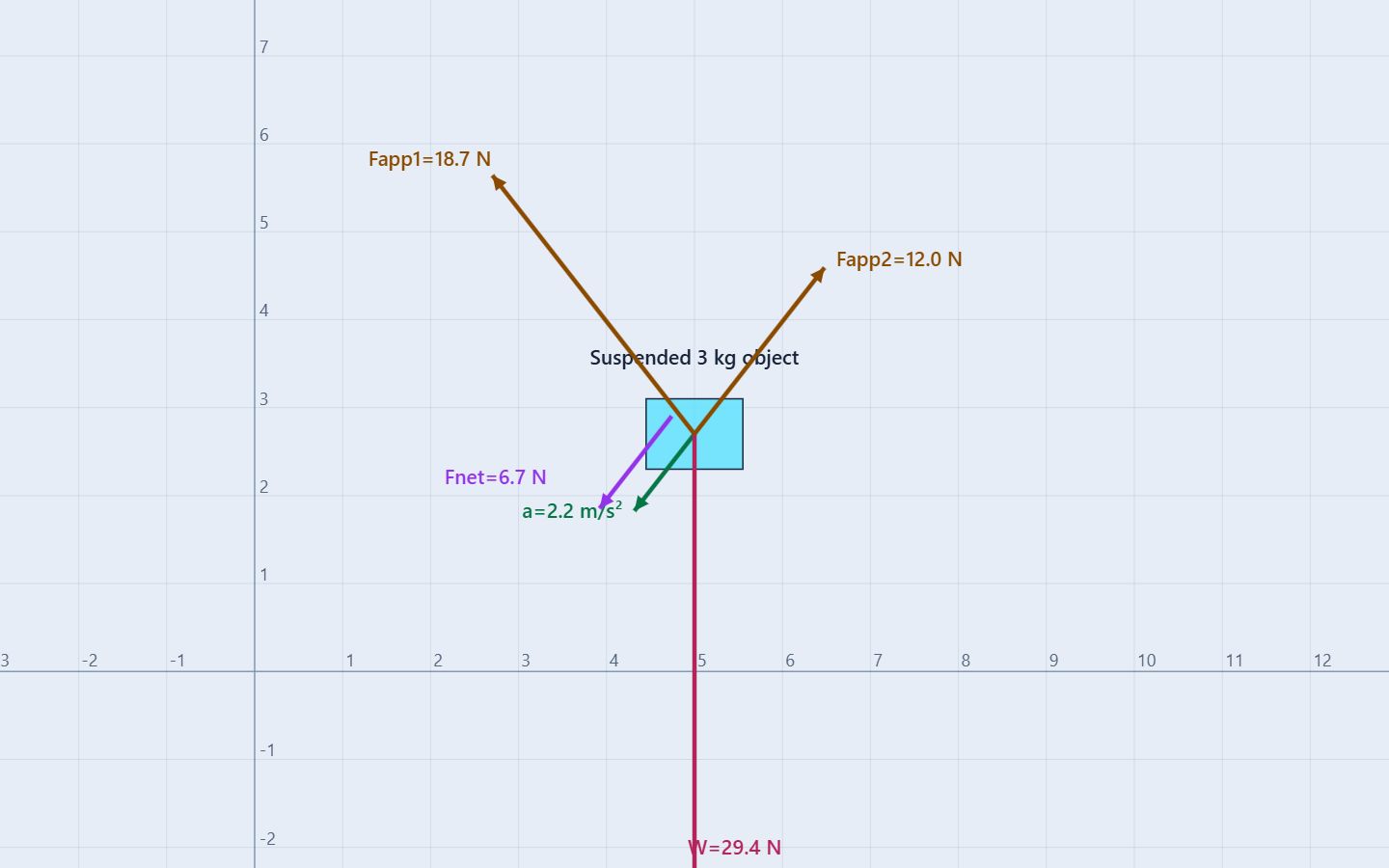
- Balance in two dimensions. Two equal support forces at 52° can cancel horizontally while their upward components balance the weight of a 3 kg object.
- Change one support force and restore balance. Any unequal support force creates a nonzero component sum. Restore the magnitude until both net-force components are approximately zero.
- Check the reference frame. The ground frame can be inertial while a platform accelerating beneath the object is non-inertial. Describe the frame before deciding whether the First Law applies directly.
| Case | Individual forces | Motion result |
|---|---|---|
| Coasting block | No horizontal force | Constant velocity |
| Balanced push and pull | +6 N and −6 N | Constant velocity |
| Crate with friction | 10 N applied and 10 N friction | Constant velocity |
| Unbalanced crate | Applied force greater than friction | Velocity changes toward the net force |
| Two-dimensional support | Horizontal components cancel; vertical components balance weight | Rest or constant velocity |
Worked examples
Write component equations before judging the motion
For a 5 kg crate on a level floor with no vertical acceleration:
ΣFy = FN − mg = 0; FN = (5.0 kg)(9.8 m/s2) = 49 N
With 10 N applied to the right and 10 N kinetic friction to the left:
ΣFx = 10 N − 10 N = 0 N; ax = 0 m/s2
The crate may be moving while this equation is true. Its velocity remains constant because acceleration is zero.
For a 3 kg object supported by two equal forces at 52° above horizontal, the horizontal components cancel by symmetry. The vertical equation is:
2T sin(52°) − (3.0 kg)(9.8 m/s2) = 0; T ≈ 18.65 N
Equilibrium types
Rest and steady motion use the same force condition
| State | Velocity | Net force | Acceleration |
|---|---|---|---|
| Static equilibrium | v = 0 | ΣF = 0 | a = 0 |
| Dynamic equilibrium | Constant nonzero v | ΣF = 0 | a = 0 |
| Unbalanced motion | Changing v | ΣF ≠ 0 | a ≠ 0 |
Individual forces do not have to disappear in equilibrium. Weight and normal force can balance, or opposing horizontal forces can balance. The test is always the vector sum and the resulting acceleration.
Inertia
Mass measures resistance to velocity change
Inertia is not another force. It is the tendency of a system to resist a change in velocity, and mass measures that tendency. For the same net force, the 2 kg block accelerates three times as much as the 6 kg block:
a2 kg = 12/2 = 6 m/s2; a6 kg = 12/6 = 2 m/s2
Both objects can be moving, resting, or changing velocity. Their mass affects how strongly a given nonzero net force changes their motion; it does not create a forward force and does not prevent zero-net-force equilibrium.
Reference frames
State the frame before applying the First Law
The ground frame is treated as inertial in the guided platform trial. A frictionless block keeps its ground-frame velocity while a platform accelerates underneath it. Relative to the platform, the block appears to shift, but that does not require a hidden leftward force on the block.
When an observer’s frame accelerates, it is non-inertial and the simple zero-net-force statement needs additional care. Separate the object’s actual interactions from the appearance of its motion relative to the accelerating frame.
Common misconceptions
Check the reasoning
Does motion require a forward force?
No. A nonzero net force changes velocity. Constant velocity continues when the net force is zero.
Does zero net force mean no forces act?
No. Several nonzero forces can cancel vectorially, such as normal force balancing weight or applied force balancing friction.
Does equilibrium require the object to be at rest?
No. Dynamic equilibrium is constant nonzero velocity. Rest is only the special case v = 0.
Does a larger mass create more inertia force?
No. Inertia is not a force. Larger mass means greater resistance to a velocity change for a given net force.
Can one balanced component hide an unbalanced one?
No. Two-dimensional equilibrium requires both ΣFx = 0 and ΣFy = 0.
For teachers
Make the velocity evidence visible
Start with a moving block and ask students what should happen when the forward force is removed. Display one velocity graph and have them distinguish a horizontal graph from a graph that slopes toward zero.
Then compare no-force and balanced-force trials. Students should report the individual forces, the net force, acceleration, and velocity separately. For two-dimensional equilibrium, require component equations before accepting a visual “looks balanced” judgment.
Continue with Free-Body Diagrams to choose system boundaries, Newton’s Second Law to analyze unbalanced forces, and the Net Force and Acceleration experiment for controlled measurements.