
Plan the investigation
Which way will the disk accelerate?
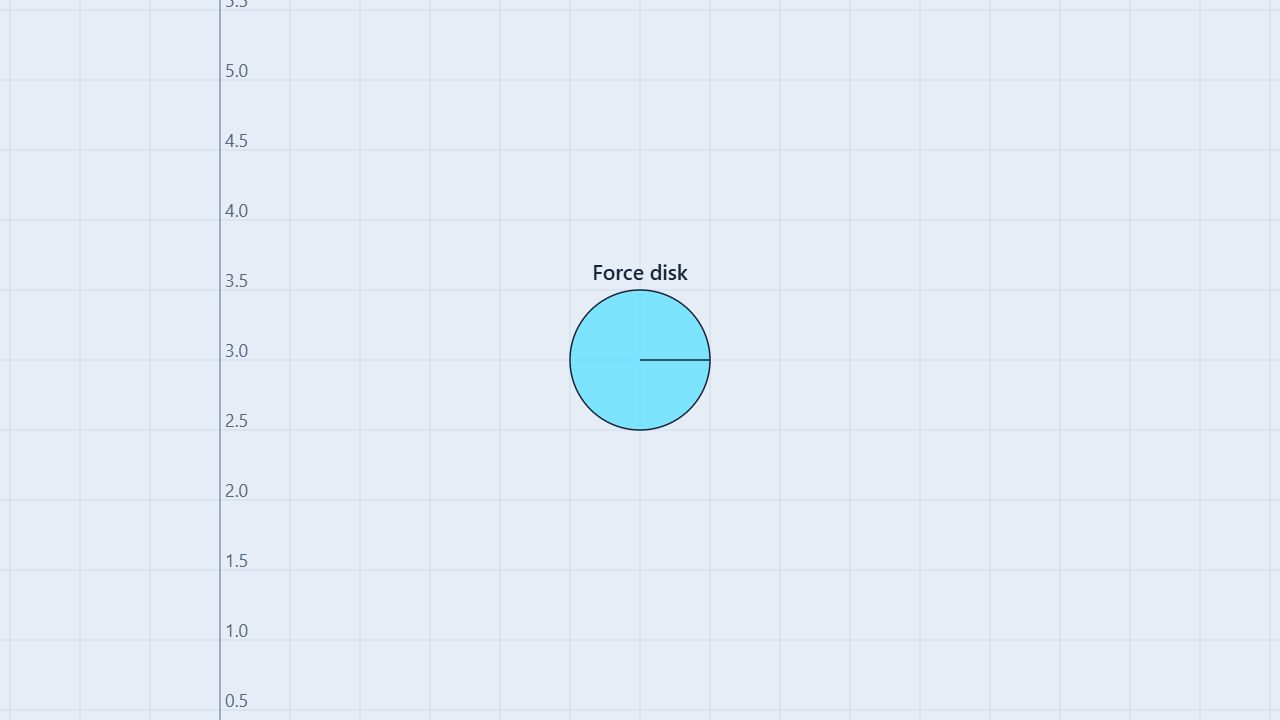
The prepared scene contains a 1 kg Force disk with rotation locked and gravity set to zero. Set its mass to 2 kg for this investigation. Use two applied forces and keep the disk clear of any surfaces.
Change
The horizontal and vertical components of two applied forces, using the five combinations below.
Keep fixed
Mass at 2 kg, zero gravity and drag, original starting position, and zero initial velocity. Keep rotation locked.
Positive x points right and positive y points up. Predict the resultant before pressing Play. The disk responds to the sum, even when no individual force points in that direction.
Build the model
Add components before finding magnitude
ΣFx = F1x + F2x
ΣFy = F1y + F2y
ax = ΣFx/m, ay = ΣFy/m
Then calculate |ΣF| = √(ΣFₓ² + ΣFᵧ²) and |a| = |ΣF|/m. Force magnitudes alone cannot tell you the resultant unless you also account for direction.
Procedure
A useful five-trial workflow
- Load and inspect. Launch the simulation and choose Net force and acceleration if a saved scene appears. In World, confirm gravity and drag are zero.
- Prepare the disk. Open Properties and select Force disk. Set Mass to 2 kg and initial velocity to zero. Under Applied forces, create or edit two forces. Remove any extra applied forces so the pair matches the table.
- Enter components. Set each force’s x and y components in newtons. For trial A, use (+6, 0) and (+2, 0). Calculate both net-force and acceleration components.
- Run and measure. Set a 0.5-second run duration beside Play. With Force disk selected, open the Data panel and choose net-force and acceleration components as graph measurements. Record a sample after motion starts, including its time. Compare components rather than only arrow lengths.
- Reset and repeat. Reset before entering each remaining pair. Restore zero initial velocity and the original position. Export CSV to preserve the readings and check the calculations.
| Trial | Force 1 (N) | Force 2 (N) | Net force (N) | Acceleration (m/s²) |
|---|---|---|---|---|
| A | (+6, 0) | (+2, 0) | (+8, 0) | (+4, 0) |
| B | (+6, 0) | (−2, 0) | (+4, 0) | (+2, 0) |
| C | (+6, 0) | (−6, 0) | (0, 0) | (0, 0) |
| D | (+6, 0) | (0, +8) | (+6, +8) | (+3, +4) |
| E | (+6, 0) | (−8, +4) | (−2, +4) | (−1, +2) |
Trials A and B differ only in the second force’s direction. Trial C balances two nonzero forces. Trials D and E require two-dimensional addition.
Worked example
A 6 N rightward push and an 8 N upward push
In trial D, the forces are perpendicular:
ΣF = (+6, +8) N
|ΣF| = √(6² + 8²) = 10 N
a = (+3, +4) m/s²; |a| = 5 m/s²
The direction is arctan(8/6) ≈ 53.1° above +x. The resultant is not 14 N: adding 6 and 8 as scalars would ignore the right angle between them.
Starting from rest, after 0.500 s the ideal velocity is (+1.50, +2.00) m/s and displacement is (+0.375, +0.500) m. These predictions assume the same constant forces act throughout the run.
Check the quadrant in trial E
The resultant (−2, +4) N points up and left. Its magnitude is √20 ≈ 4.472 N and its direction is about 116.6° counterclockwise from +x. Use the component signs when choosing a direction; a plain inverse tangent can hide the quadrant.
Common misconception
Does the strongest force decide the motion?
All external forces contribute to acceleration. In trial E, neither applied force has the same direction as the resultant.
Do balanced forces mean no forces?
No. Trial C has two 6 N forces that cancel. Zero net force means zero acceleration, not the absence of interactions.
Does zero net force stop a moving disk?
No. It preserves velocity. Trial C stays still because it starts from rest; a disk already moving would continue at constant velocity when other forces are absent.
Should I add the displayed net-force arrow too?
No. It represents the sum of the applied forces in this zero-gravity setup. Adding it again would count those forces twice.
Does velocity always point along net force?
No. Acceleration points along net force. An existing velocity can point elsewhere, making the path curve as acceleration changes the velocity.
Predict before running
Balance a diagonal resultant
Start with trial D. What third force would make acceleration zero?
Reveal the prediction
Add (−6, −8) N. Its magnitude is 10 N and it points opposite the original resultant. The component sums are then both zero. Reset before testing so the difference between rest and constant velocity is clear.
For teachers
Connect vector addition with Newton’s second law
Have students draw the two force vectors head-to-tail, then compare the resultant with the component calculation. Require both magnitude and direction in their conclusion.
Repeat trial D with a 4 kg disk: acceleration components halve to (+1.5, +2) m/s² while the net force stays (+6, +8) N. For a curved-path extension, give the disk an initial velocity perpendicular to a constant net force and distinguish velocity direction from acceleration direction.
Review Free-Body Diagrams and continue with the Newton’s Second Law experiment for controlled force and mass comparisons. Physics reference: OpenStax, University Physics Volume 1, §5.3. Learn about the educator behind these simulations on the BuildPhysics About page.