
Core idea
Friction depends on contact and relative motion
Friction is an interaction between a pair of contacting surfaces. The coefficients belong to that pair, not to one object by itself. Decide first whether the surfaces remain stuck or slide relative to one another, then choose the model.
Static friction prevents attempted relative motion and adjusts from zero up to a maximum: 0 ≤ fs ≤ μsFN. Kinetic friction acts after sliding begins with the model fk = μkFN. In both cases, friction points opposite the relative sliding or attempted sliding at the contact.
Sticking
Find the friction required for equilibrium. Check that it does not exceed μsFN.
Sliding
Use μkFN with the direction opposite relative motion, then include friction in the net-force equation.
Guided lesson path
Start with a horizontal block, then turn the surface
- Identify the surface pair. Moving a block from wood to ice can change both friction coefficients because the contacting materials changed.
- Find the normal force. A 4 kg block on a level surface with no other vertical force has FN = mg = 39.2 N.
- Check for attempted sliding. With no horizontal force, actual static friction is zero. It is not automatically at its maximum.
- Calculate the static limit. For μs = 0.50, fs,max = μsFN = 19.6 N.
- Apply an 8 N push. Because 8 N is below the limit, static friction is 8 N left and the block remains at rest.
- State the static-friction rule. The coefficient gives an upper limit. The actual value is whatever is needed to prevent relative motion, from zero through that limit.
- Exceed the limit. A 24 N push is too large for 19.6 N of static friction, so the block begins sliding right.
- Switch to kinetic friction. With μk = 0.25, sliding friction is 9.8 N left. The 24 N push leaves 14.2 N net force and ax = 3.55 m/s2 right.
- Compare starting and sliding. The maximum static friction is 19.6 N, while kinetic friction is 9.8 N. Starting the slide requires more force than maintaining it.
- Keep a sliding block at constant speed. A block already moving right at 2 m/s needs a 9.8 N applied force right to balance 9.8 N kinetic friction left.
- Press down on the block. A 12 N downward force raises the normal force from 39.2 N to 51.2 N, so kinetic friction becomes 12.8 N.
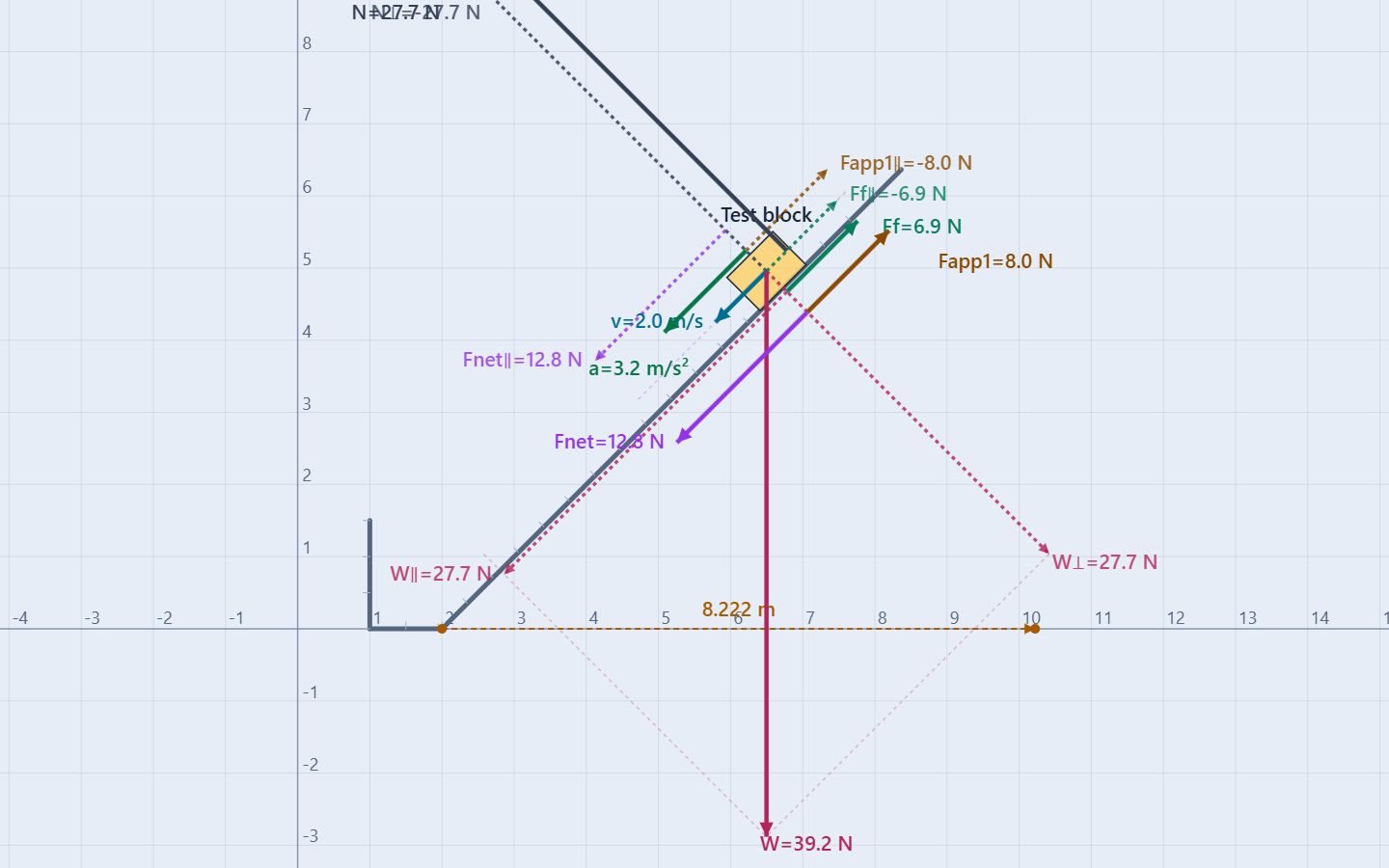
- Move to a rough incline. On a 20° ramp, gravity attempts to slide a 4 kg block downhill, so static friction points up the ramp when it prevents that attempted motion.
- Resolve the normal force. Only the perpendicular weight component presses into the ramp: FN = mg cos20° ≈ 36.84 N, less than the 39.2 N weight.
- Find actual static friction. The downhill component is mg sin20° ≈ 13.41 N. Because this is below the 18.42 N static limit, actual friction is 13.41 N up the ramp and acceleration is zero.
- Derive the critical angle. At the slipping threshold, mg sinθc = μsmg cosθc, so tanθc = μs. For μs = 0.50, θc ≈ 26.6°.
- Test mass independence. Mass and g cancel from the critical-angle equation. Doubling mass changes force magnitudes but not the angle at which slipping begins.
- Push a sliding crate up a ramp. For a 4 kg crate sliding down a 45° ramp, an 8 N up-ramp push and 6.93 N kinetic friction still leave 12.79 N down-ramp net force, or about 3.20 m/s2 down.
- Use the complete strategy. Choose the object, find the normal force, classify sticking or sliding, set the friction direction from relative motion, and then apply Newton’s Second Law along the chosen axis.
| Applied force | Contact state | Friction | Acceleration |
|---|---|---|---|
| 0 N | Sticking | 0 N | 0 m/s2 |
| 8 N right | Sticking | 8 N left | 0 m/s2 |
| 24 N right | Sliding | 9.8 N left | 3.55 m/s2 right |
| 9.8 N right while sliding | Sliding | 9.8 N left | 0 m/s2 |
| 12 N downward while sliding | Sliding | 12.8 N opposite motion | Changes with the new net force |
Worked examples
Separate the limit from the actual force
For the level 4 kg block:
FN = mg = (4.0 kg)(9.8 m/s2) = 39.2 N
fs,max = μsFN = (0.50)(39.2 N) = 19.6 N
With a 24 N push right after sliding begins:
fk = (0.25)(39.2 N) = 9.8 N
ΣFx = 24 N − 9.8 N = 14.2 N; ax = 14.2/4.0 = 3.55 m/s2
With a 12 N downward press while sliding:
FN = 39.2 N + 12 N = 51.2 N; fk = (0.25)(51.2 N) = 12.8 N
Friction on an incline
Use ramp components before choosing friction
On a ramp, resolve weight into mg sinθ down the surface and mg cosθ into the surface. The normal force is usually FN = mg cosθ when no other perpendicular force acts. The required static friction is the amount needed to balance the parallel forces, not automatically μsFN.
| Ramp angle | mg sinθ (N) | μsFN (N) | Result |
|---|---|---|---|
| 20° | 13.41 | 18.42 | Stays at rest; fs = 13.41 N up ramp |
| 26.6° | 18.42 | 18.42 | Critical threshold |
| 35° | 22.52 | 16.06 | Slides; use kinetic friction |
| 45° with 8 N up-ramp push | 27.72 | 13.86 max static | Sliding net force remains down ramp |
After sliding begins on the 35° ramp, the downhill net force is mg sin35° − μkmg cos35°. Static and kinetic friction are different models, so do not keep using the static limit after the block has slipped.
Normal force
Friction changes when the contact force changes
Friction depends on FN, not directly on the block’s speed. A downward applied force increases FN and therefore increases kinetic friction. An upward force can reduce contact force and may eventually lift the block off the surface, at which point the contact-friction model no longer applies.
On an incline, the normal force is set by the perpendicular force balance. This is why a ramp’s normal force is smaller than mg and why changing the ramp angle changes both the friction limit and the sliding acceleration.
Common misconceptions
Check the reasoning
Is static friction always μsFN?
No. That expression is the maximum possible static friction. The actual value adjusts from zero to that limit as needed.
Does friction exist whenever surfaces touch?
Contact allows friction, but actual static friction can be zero when there is no attempted relative motion.
Does friction always point opposite velocity?
Friction opposes relative sliding or attempted sliding between the surfaces. Determine the contact’s relative motion, especially when an object is pushed or pulled by another interaction.
Is kinetic friction larger because the object is moving?
Not necessarily. In this model μk is smaller than μs, so kinetic friction is below the maximum static friction for the same normal force.
Does a zero acceleration mean friction is zero?
No. Applied force and friction can balance while the block is moving at constant velocity, or static friction can balance a downhill component while the block remains at rest.
Are weight components extra forces?
No. mg sinθ and mg cosθ are components of one weight vector. Use either the full vector or its components consistently.
Does mass change the critical angle?
No. Mass and g cancel from tanθc = μs. Different mass changes force magnitudes but not the material threshold.
For teachers
Make students classify the contact first
Begin with the level block and ask students to predict the actual friction for 0 N and 8 N before showing the maximum. Then exceed the 19.6 N limit with a 24 N push and have them switch explicitly to μkFN.
Use the downward-press trial to separate speed from normal force, then move to the 20° incline. Require students to calculate the required static friction and compare it with its maximum before deciding whether the block moves. Finish with θc = tan−1(μs) and a sliding crate with an applied up-ramp force.
Continue with Free-Body Diagrams for contact-force models, Inclined Planes for ramp components, and the Critical Angle and Friction experiment for the full simulation workflow.