
Plan the investigation
How high can the spring launch the projectile?
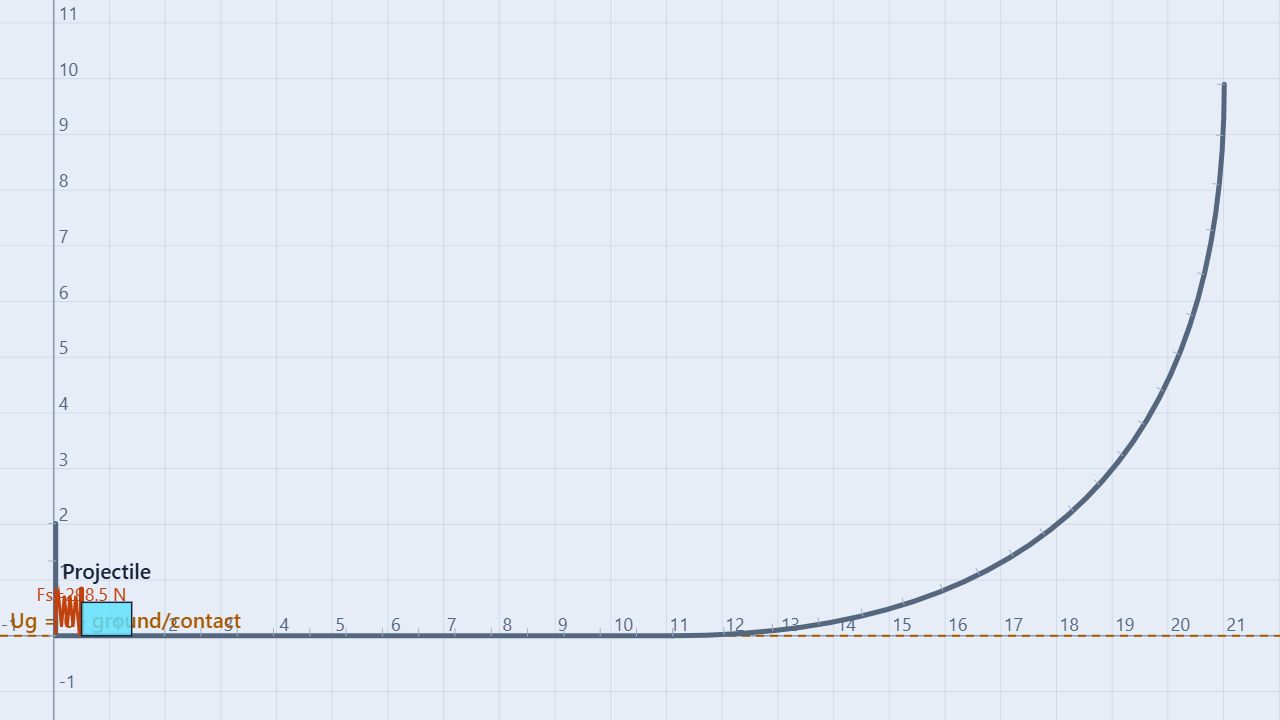
The prepared scene starts with a 5 kg projectile against a horizontal launcher spring. The spring has k = 120 N/m and begins compressed by about 2.487 m. The projectile first moves across a frictionless horizontal surface at y = 0, then climbs a curved ramp whose endpoint is y = 9.900 m.
Us = ½kx²
Us → K → Ug
Ug = mgy
Change one variable
Change the launcher’s relaxed length to change compression, or change projectile mass. Keep the spring constant, ramp shape, gravity, and friction setting fixed for a fair comparison.
Measure the turning point
Record compression, elastic energy, speed, center height, and the highest point reached. At the turning point, the projectile’s speed is momentarily zero.
The preset uses zero friction on the launch surface and ramp, disables the global friction toggle, and sets the gravitational-potential reference at y = 0. The normal force keeps the projectile on the ramp; for a stationary frictionless ramp, it redirects motion without changing mechanical energy.
Build the model
Use energy to connect compression and height
During the launch, ideal elastic energy becomes kinetic energy. As the projectile climbs the ramp, kinetic energy becomes gravitational potential energy. If the projectile starts from rest and losses are negligible:
Us,i = ½kx²
½kx² = ½mv² + mgy
½kx² = mgΔymax
Δymax = kx²/(2mg)
The mass cancels from the height equation only when the same spring compression and an ideal frictionless path are used. The launch speed still depends on mass: v = x√(k/m). A heavier projectile starts up the same ramp more slowly, but the ideal maximum height is unchanged because it also requires proportionally less kinetic energy for a given speed.
The ramp’s curved shape changes the direction of the velocity and the normal force. It does not change the ideal height prediction. Use vertical center-height change, not the distance measured along the curved surface, for Δy.
Procedure
Measure the spring, speed, and turning point
- Load and inspect. Open the Spring Launch Up a Curved Ramp simulation. Select the projectile and record its mass. Select the launcher and record k, relaxed length, and the displayed compression before running.
- Calculate stored energy. Use Us = ½kx². Record compression in meters and energy in joules; the relaxed length is not the compression.
- Predict the launch. Calculate the ideal horizontal speed from ½kx² ≈ ½mv². State the assumptions: zero friction, a level launch surface, and negligible energy loss during contact.
- Run the baseline. Start from rest and run until the projectile climbs the curved ramp and reverses direction. Record speed and center height at several points, especially near the highest point.
- Check the turning point. Calculate Δymax = Us/(mg), then add that height gain to the projectile’s starting center height. Compare the result with the largest measured center y.
- Change compression. Reset, change only the launcher’s relaxed length, and repeat at three compressions. Plot maximum height gain against x². The ideal model predicts a straight line through the origin.
- Change mass. Reset to the original compression and change only the projectile mass. Compare launch speed, time to climb, and maximum height. A longer travel time does not imply a different ideal height.
- Export evidence. Keep measured center heights and speeds separate from calculated energy values. Report any difference between predicted and measured turning height as a model discrepancy to investigate.
| Quantity | Calculation | Prediction |
|---|---|---|
| Spring compression | Launcher readout | 2.487 m |
| Stored elastic energy | ½(120)(2.487)² | 371.2 J |
| Ideal launch speed | √(2 × 371.2 / 5.00) | 12.19 m/s |
| Maximum center-height gain | 371.2 / (5.00 × 9.80) | 7.576 m |
| Starting projectile center | On y = 0 surface | 0.300 m |
| Ideal maximum center height | 0.300 + 7.576 | 7.876 m |
The curved ramp reaches y = 9.900 m, so the ideal turning point is below its endpoint. That gives the baseline a useful check: the projectile should reverse direction on the ramp before reaching the vertical end, provided the measured run stays close to the lossless model.
Compare trials
Height depends on compression squared
For the prepared k = 120 N/m spring and m = 5.00 kg, the ideal height gain is Δy = 120x²/(2 × 5.00 × 9.80). The table below shows calculated trial values, not measurements from separate runs.
| Compression x (m) | Stored energy (J) | Height gain (m) | Maximum center y (m) |
|---|---|---|---|
| 1.00 | 60.0 | 1.224 | 1.524 |
| 1.50 | 135.0 | 2.755 | 3.055 |
| 2.00 | 240.0 | 4.898 | 5.198 |
| 2.487 | 371.2 | 7.576 | 7.876 |
A plot of maximum height gain against x² should be linear with slope k/(2mg) ≈ 1.224 m per m². A plot against x itself curves upward, which is the visual signature of the squared relationship.
Worked example
Halving compression cuts height gain to one quarter
Suppose the prepared spring is compressed to half of its baseline value, about x = 1.244 m. The stored energy and height gain are:
Us = ½(120)(1.244)² = 92.8 J
Δymax = 92.8/(5.00 × 9.80) = 1.894 m
ymax,center = 0.300 + 1.894 = 2.194 m
Half the compression produces one quarter of the stored energy and one quarter of the ideal height gain. The launch speed is only half as large because v is proportional to x, but the height depends on v².
Interpret the evidence
Use speed and height graphs together
As the projectile climbs, speed decreases while gravitational potential energy increases. A useful check at any measured center height is:
½mv² + mgy ≈ constant
v² = v0² − 2g(y − y0)
Plot v² against center height y for points on the ramp. The ideal slope is −2g, independent of the ramp’s shape. Plot total mechanical energy alongside kinetic and gravitational potential energy; the total should remain nearly flat in the frictionless preset.
If the measured maximum height is lower than predicted, check whether the projectile picked up a nonzero launch angle, whether the compression was read before the spring settled, or whether contact corrections and numerical integration caused a small loss. Do not “fix” the result by replacing vertical height with ramp distance.
Common misconceptions
Check the reasoning
Does a longer curved ramp produce more gravitational energy?
No. Gravitational potential energy depends on vertical height change, m g Δy, not the path length.
Is spring energy kx?
No. kx is the spring-force magnitude. Stored elastic energy is ½kx².
Does the normal force add energy on the ramp?
No. For a stationary frictionless ramp, the normal force is perpendicular to the instantaneous motion and does no work.
Does zero speed at the turning point mean zero acceleration?
No. Speed is momentarily zero, but gravity can still have a component along the ramp that starts the projectile back down.
Does changing projectile mass change the ideal maximum height?
At fixed spring compression and with no losses, mass cancels from Δy = kx²/(2mg) after the launch energy is divided by m. Measured losses can make real trials differ.
For teachers
Make the squared relationship visible
Have students calculate the baseline before pressing Run. Require a table with compression, calculated Us, measured speed, center height, and calculated total mechanical energy. Ask them to identify which values come from the simulator and which come from the model.
Use three compression trials and compare linear fits for maximum height versus x and maximum height versus x². Then repeat one compression with a different mass to separate the speed prediction from the height prediction.
Continue with Spring-Launched Projectile to connect the same launcher model to flight range, or Skater Bowl to study gravitational and kinetic energy without a spring. Review Hooke’s Law and Conservation of Energy.
Physics references: OpenStax, College Physics 2e, §16.2 and OpenStax, College Physics 2e, §8.3. Learn about the educator behind these simulations on the BuildPhysics About page.