
Core idea
Every interaction creates a matched pair
Whenever object A exerts a force on object B, object B simultaneously exerts a force of equal magnitude in the opposite direction on object A. The two arrows are one interaction viewed from its two ends:
FA on B = −FB on A
|FA on B| = |FB on A|
The pair has the same interaction type, opposite directions, equal magnitudes, and different target objects. Naming the source and target keeps the bookkeeping clear: the first subscript names who exerts the force, and the second names who receives it.
Same interaction
Contact, gravity, normal, spring, and friction interactions each produce their own source–target pair.
Different responses
Equal forces can produce different accelerations because each object may have a different mass.
Guided lesson path
Follow the source, target, and system boundary
- Start with one interaction. The contact between a pusher and a block produces two horizontal arrows, not one arrow that belongs to both objects.
- Name the source and target. If a 2 kg pusher contacts a 4 kg block, label the force from the pusher on the block as Fpusher on block. Its partner is Fblock on pusher.
- Run the contact trial. Give the two-block system a 12 N external push. The contact arrows are equal in magnitude and opposite in direction, about 8 N each for the 2 kg and 4 kg blocks.
- Calculate the system acceleration. The total mass is 6 kg, so the external 12 N push gives asys = 12/6 = 2 m/s2 to the right.
- Find the force on the 4 kg block. Its horizontal net force must be mblocka = (4 kg)(2 m/s2) = 8 N to the right. That is the contact force from the pusher.
- Inspect only the 4 kg block. Its free-body diagram contains the 8 N contact force and any other forces acting on that block. Do not add the partner force because the partner acts on the pusher.
- Inspect only the 2 kg pusher. The pusher has 12 N right from the external push and 8 N left from the block, leaving 4 N net force right. Its acceleration is still 2 m/s2 because 4/2 = 2.
- Check the common misconception. The 8 N right and 8 N left contact arrows do not cancel on either individual diagram. They act on different objects, so they are a third-law pair rather than balanced forces on one object.
- Combine both blocks into one system. The contact pair is now internal to the chosen system, so those forces cancel in the system equation. The external 12 N force remains and produces asys = 2 m/s2.
- Change the external push. Increase the push to 18 N while keeping the masses at 2 kg and 4 kg. The system acceleration becomes 3 m/s2, and the contact pair becomes 12 N in opposite directions.
- Remember simultaneity. The pusher does not act first and the block react later. Both forces exist at the same time, and neither force is caused by the other arriving after a delay.
- Use the same rule for propulsion. A rocket pushes exhaust backward, and the exhaust pushes the rocket forward. The pair does not require air or a ground surface.
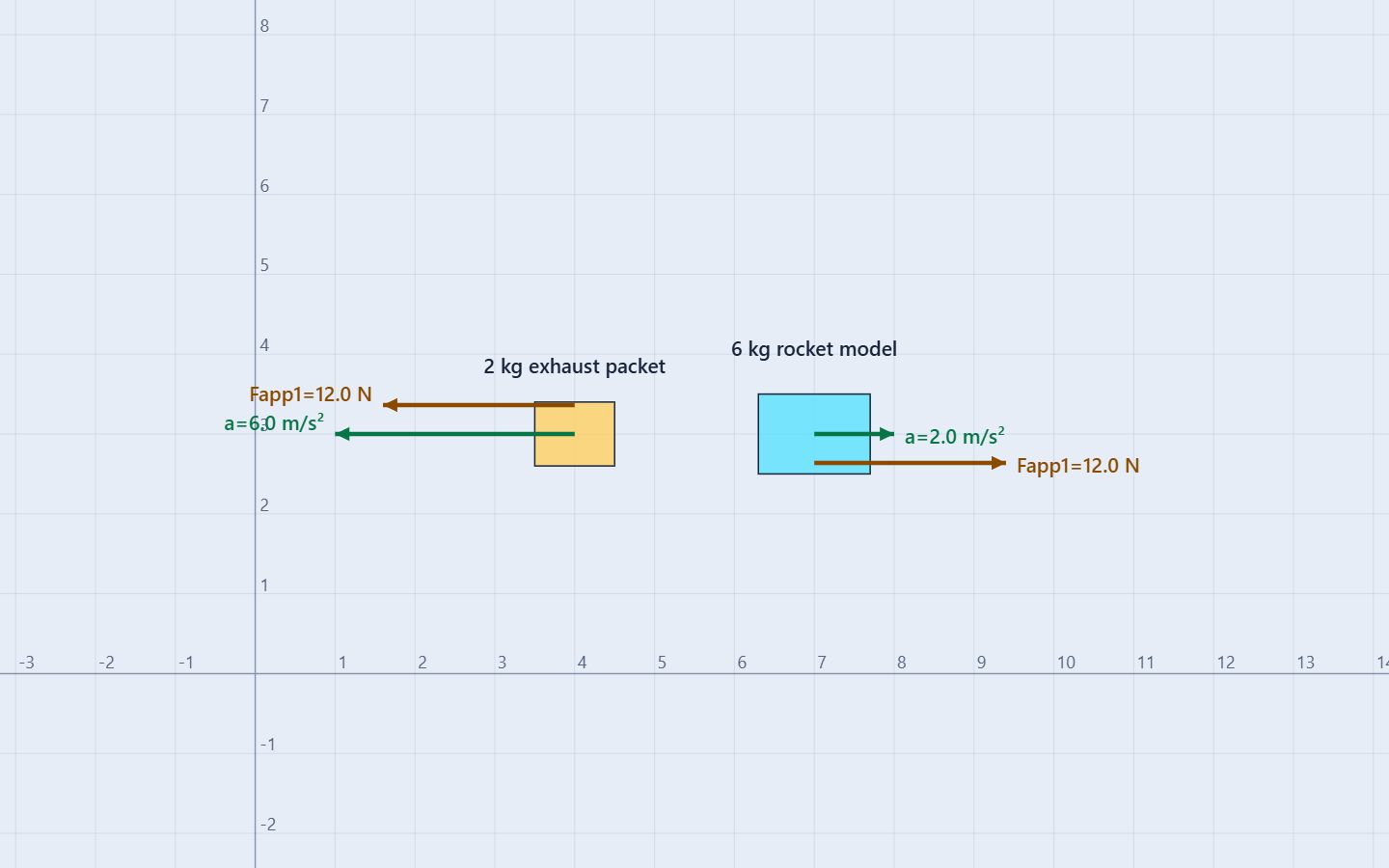
- Compare unequal masses. If a 2 kg exhaust packet and a 6 kg rocket experience a 12 N interaction pair, the packet has aexhaust = 6 m/s2 while the rocket has arocket = 2 m/s2.
- Repeat with equal masses. Two 4 kg objects receiving equal interaction forces have equal acceleration magnitudes in opposite directions. Equal force does not guarantee equal acceleration when the masses differ.
- Rest a glass on Earth. The glass has a 39.2 N weight down and a 39.2 N normal force up, so those forces balance on the glass. They are not a third-law pair because they act on the same object.
- Find the weight partner. The partner to Earth’s gravitational force on the glass is the glass’s gravitational force on Earth, not the normal force from the floor.
- Find the normal-force partner. The partner to the floor’s normal force on the glass is the glass’s normal force on the floor. Both members are contact forces between the same two objects.
- Apply the model to a fly and car. During a collision, the fly and car exert equal forces on one another. The fly’s much smaller mass gives it the much larger acceleration response.
- Recognize walking as an interaction. Your foot pushes the Earth backward through friction, and the Earth pushes your foot forward through friction. The forward force comes from the partner interaction.
- Finish with the four-part test. A valid third-law pair has equal magnitude, opposite direction, the same interaction type, and different target objects. Then use Newton’s Second Law separately for each target.
| External push | System acceleration | Contact pair | Pusher net force |
|---|---|---|---|
| 12 N right | 2 m/s2 right | 8 N right / 8 N left | 4 N right |
| 18 N right | 3 m/s2 right | 12 N right / 12 N left | 6 N right |
Worked examples
Write each force with its source and target
For the 12 N contact trial, treat both blocks as one system first:
msys = 2 kg + 4 kg = 6 kg
asys = Fexternal/msys = 12 N/6 kg = 2 m/s2 right
Now select the 4 kg block. The pusher’s contact force is the only horizontal force in this simplified block model:
Fpusher on block = mblockablock = (4 kg)(2 m/s2) = 8 N right
Fblock on pusher = 8 N left
For the pusher, include the external push and its contact force:
ΣFpusher,x = 12 N − 8 N = 4 N right
apusher = 4 N/2 kg = 2 m/s2 right
For propulsion with a 2 kg exhaust packet and a 6 kg rocket:
|Frocket on exhaust| = |Fexhaust on rocket| = 12 N
aexhaust = 12/2 = 6 m/s2; arocket = 12/6 = 2 m/s2
Pair or balance?
Use the target-object test
Forces cancel in a free-body diagram only when they act on the same chosen object or system. Third-law partners always point opposite ways, but they act on different target objects. Ask “what object receives this arrow?” before deciding whether two arrows can appear in the same net-force equation.
| Situation | Third-law pair | Balanced forces on one object |
|---|---|---|
| Glass at rest | Earth on glass / glass on Earth | Earth on glass weight / floor on glass normal |
| Two blocks in contact | Pusher on block / block on pusher | Only if forces on one selected block sum to zero |
| Rocket propulsion | Rocket on exhaust / exhaust on rocket | External forces may separately balance on a selected rocket |
| Walking | Foot on Earth / Earth on foot | Other forces can balance on the person, but not this pair |
When both blocks are selected as one system, the contact pair is internal and disappears from the system’s external-force sum. That cancellation is a consequence of the system boundary, not evidence that the two forces act on the same block.
Interaction types
Match the partner to the same physical interaction
| Interaction | One force | Its partner |
|---|---|---|
| Contact | pusher on block | block on pusher |
| Gravity | Earth on glass | glass on Earth |
| Normal/contact | floor on glass | glass on floor |
| Spring or propulsion | rocket on exhaust | exhaust on rocket |
| Friction | foot on Earth | Earth on foot |
Force versus response
Equal interaction forces can produce unequal accelerations
Newton’s Third Law fixes the two force magnitudes, while Newton’s Second Law determines how each object responds. A smaller object has less inertia, so the same interaction force changes its velocity more quickly. This explains the different accelerations of a rocket and exhaust packet and the dramatic response of a fly in a car collision.
Do not infer force magnitude from the size of an acceleration arrow. Identify the interaction pair first, then calculate each object’s acceleration from a = ΣF/m.
Common misconceptions
Check the reasoning
Does the larger or faster object exert the larger force?
No. The interaction forces are equal in magnitude. Different masses can still give the objects different accelerations.
Do action and reaction happen one after the other?
No. The two forces are simultaneous members of one interaction.
Do equal and opposite forces cancel on an individual free-body diagram?
No. Third-law partners act on different objects. They cancel only as internal forces when the chosen system includes both target objects.
Are weight and normal force a third-law pair?
No. For a resting glass, both act on the glass and can balance. The partner to the glass’s weight is the glass’s gravitational force on Earth; the partner to the normal force is the glass’s force on the floor.
Does a rocket need air to move forward?
No. The rocket and exhaust exert equal and opposite forces on each other. The exhaust provides the interaction partner even in empty space.
Do equal forces mean equal accelerations?
No. Use a = F/m for each object. Equal masses give equal acceleration magnitudes; unequal masses do not.
For teachers
Make every arrow answer two questions
Ask students to label every force as “source on target” before they add vectors. Run the 2 kg and 4 kg contact trial, have students draw separate free-body diagrams, and then redraw the pair as one system so the internal cancellation has a visible reason.
Use the 18 N trial to show that changing the external push changes both acceleration and contact-force magnitude. Finish with the glass, rocket, fly, and walking examples so students practice matching interaction type and target object instead of memorizing an arrow pattern.
Continue with Free-Body Diagrams for system boundaries, Newton’s Second Law for acceleration responses, and the Newton’s Third Law experiment for the interactive contact and propulsion trials.