
Core idea
Use one workflow for every kinematics problem
Kinematics describes how position, displacement, velocity, and acceleration change without asking what interaction causes the motion. A reliable solution starts by choosing coordinates and a positive direction, listing what is known, and identifying what remains constant. Then select the representation that makes the relationship visible: a motion diagram, a table, a graph, a vector triangle, or an equation.
Graph relationships connect the whole unit. The slope of an x–t graph gives velocity, the slope of a v–t graph gives acceleration, the area under a v–t curve gives displacement, and the area under an a–t curve gives the change in velocity. Portions below the time axis contribute negative values because direction is part of the quantity.
Define the model
Choose +x and +y, identify the initial state, and write the acceleration components before substituting numbers.
Check the evidence
Compare a graph slope, area under the curve, vector component, or limiting case with the equation result.
Guided review path
Connect the Unit 1 representations
- Separate path length from displacement. For a traveler moving 8 m right and 6 m left, distance is 14 m while displacement is +2 m. The path and the endpoints answer different questions.
- Use constant-velocity evidence. At +4 m/s for 1.0 s, displacement is +4 m. Doubling velocity at the same time doubles displacement.
- Read graph slope and area under the curve. Position slope gives velocity; a velocity graph’s area gives displacement. A longer constant-velocity interval makes the rectangle area grow in direct proportion to time.
- Recognize constant acceleration. A velocity increase of +3 m/s every second means a = +3 m/s². The position graph curves because its slope is changing.
- Scale free fall. A 2 kg ball and an 8 kg ball released together have the same ideal acceleration. For a drop from rest, height scales with t², so four times the height takes twice the time.
- Build and add vectors. A 6–8 component pair has magnitude 10 m/s. Doubling both components doubles the magnitude without changing direction; add separate x and y components to form a resultant.
- Change reference frames. Boat/ground velocity equals boat/water velocity plus water/ground velocity. Changing an eastward current changes the ground-relative x component while leaving the northward component unchanged.
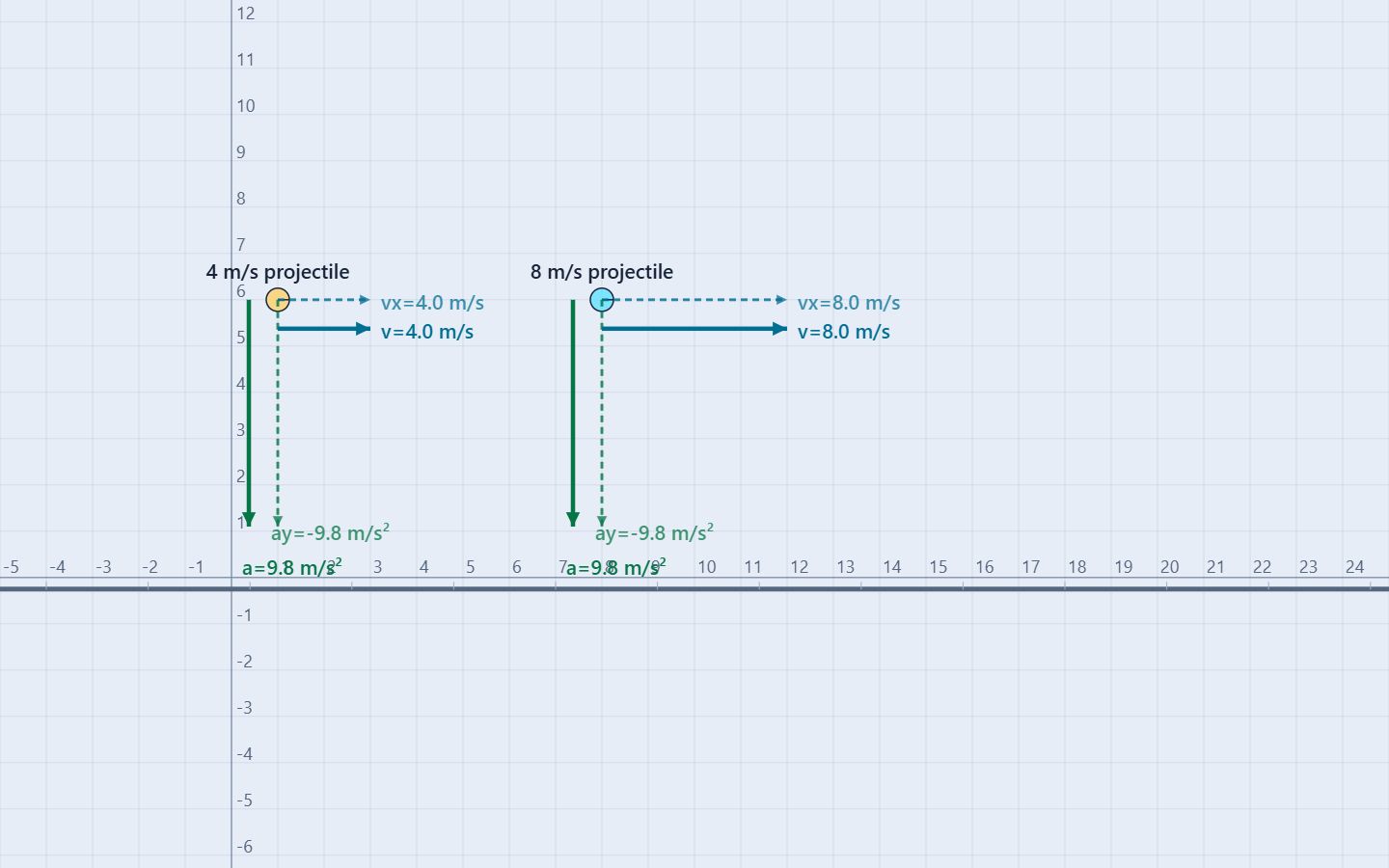
- Apply the projectile model. A horizontal-speed change affects range but not ideal vertical motion. A four-times-higher horizontal launch takes twice as long and travels twice as far when vx is fixed.
- Finish with a mixed representation check. Translate a table into an acceleration statement, then compare vector scaling and angled-launch scaling to see whether the result is proportional, square-root, or squared.
| Question | Useful evidence | Relationship |
|---|---|---|
| How fast is position changing? | Slope of x–t | v = Δx/Δt |
| How fast is velocity changing? | Slope of v–t | a = Δv/Δt |
| How much position changed? | Area under v–t curve | Δx = area under the curve |
| How much velocity changed? | Area under a–t curve | Δv = area under the curve |
| What is a 2D magnitude? | Component triangle | |v| = √(vx2 + vy2) |
Worked examples
Let the known quantities choose the equation
For constant acceleration, use the relationship that contains the quantities you know. If vi = 2.0 m/s, a = 4.0 m/s², and Δt = 3.0 s:
vf = vi + aΔt = 2.0 + (4.0)(3.0) = 14.0 m/s
For a velocity that begins at +2.0 m/s and accelerates at +5.0 m/s² for 2.0 s:
Δx = viΔt + ½a(Δt)2 = (2.0)(2.0) + ½(5.0)(2.0)2 = 14.0 m
The same displacement appears as the area under the v–t curve: a rectangle from the initial velocity plus a triangle from the velocity increase.
For a velocity vector with vx = 6 m/s and vy = 8 m/s:
|v| = √(62 + 82) = 10 m/s
Scaling checks
Identify what changes before comparing outcomes
| Controlled condition | Change | Result |
|---|---|---|
| Constant velocity and fixed time | Velocity doubles | Displacement doubles |
| Constant acceleration and fixed time from rest | Acceleration doubles | Velocity change and displacement double |
| Same braking acceleration | Initial speed doubles | Stopping distance becomes four times as large |
| Drop from rest | Height becomes four times as large | Fall time doubles |
| Same launch angle and equal heights | Launch speed doubles | Flight time doubles; height and range become four times as large |
These comparisons work only when the stated controls remain fixed. Before saying that a quantity doubles, identify whether the relationship is direct, square-root, or squared and name the condition that makes the comparison valid.
Mixed-problem strategy
Translate before calculating
A motion table with x = 0, 4, 12 m and vx = 2, 6, 10 m/s at t = 0, 1, 2 s shows a constant +4 m/s² acceleration with initial velocity 2 m/s. The changing position increments confirm that velocity is not constant.
For a projectile, use the vertical component to find the shared flight time, then use Δx = vxΔt for range. For a vector, add matching components before finding the magnitude. For relative motion, write the reference-frame subscripts before adding anything.
At the top of an upward launch, vy = 0 does not mean the acceleration is zero. In a projectile, vx remains nonzero and ay remains downward. This single check catches several common errors at once.
Common misconceptions
Check the reasoning
Does a negative value always mean slowing down?
No. A negative velocity or acceleration describes direction relative to the chosen axis. Speed changes according to whether the velocity and acceleration point in the same or opposite directions.
Does constant acceleration mean equal distances each second?
No. Constant acceleration gives equal velocity changes in equal times. The distance covered in each interval changes as the velocity changes.
Does zero vertical velocity mean zero acceleration?
No. At an apex, vertical velocity is momentarily zero while gravity continues to accelerate the object downward.
Can vector magnitudes be added before directions?
Not in general. Add x components and y components first, then calculate the resultant magnitude and direction.
Does a faster projectile fall faster?
Not when only its horizontal speed changes. In the ideal model, horizontal and vertical motion are independent and share the same clock.
For teachers
Use the review as a representation choice lesson
Give students a motion description, table, graph, or vector and ask which quantity can be read directly before they calculate. Require a coordinate convention and a one-sentence reason for every sign.
Keep one graph series visible at a time and use “area under the curve” consistently when discussing displacement or velocity change. Finish with a mixed prompt that requires a graph relationship, a component equation, and a scaling argument in the same solution.
Use the focused guides for another pass through Displacement and Velocity, Constant Acceleration, 2D Vectors and Relative Motion, and Projectile Motion. The Constant Acceleration Simulation and Virtual Lab provides a prepared data-collection setup.