
Plan the investigation
What happens when the table mass increases?
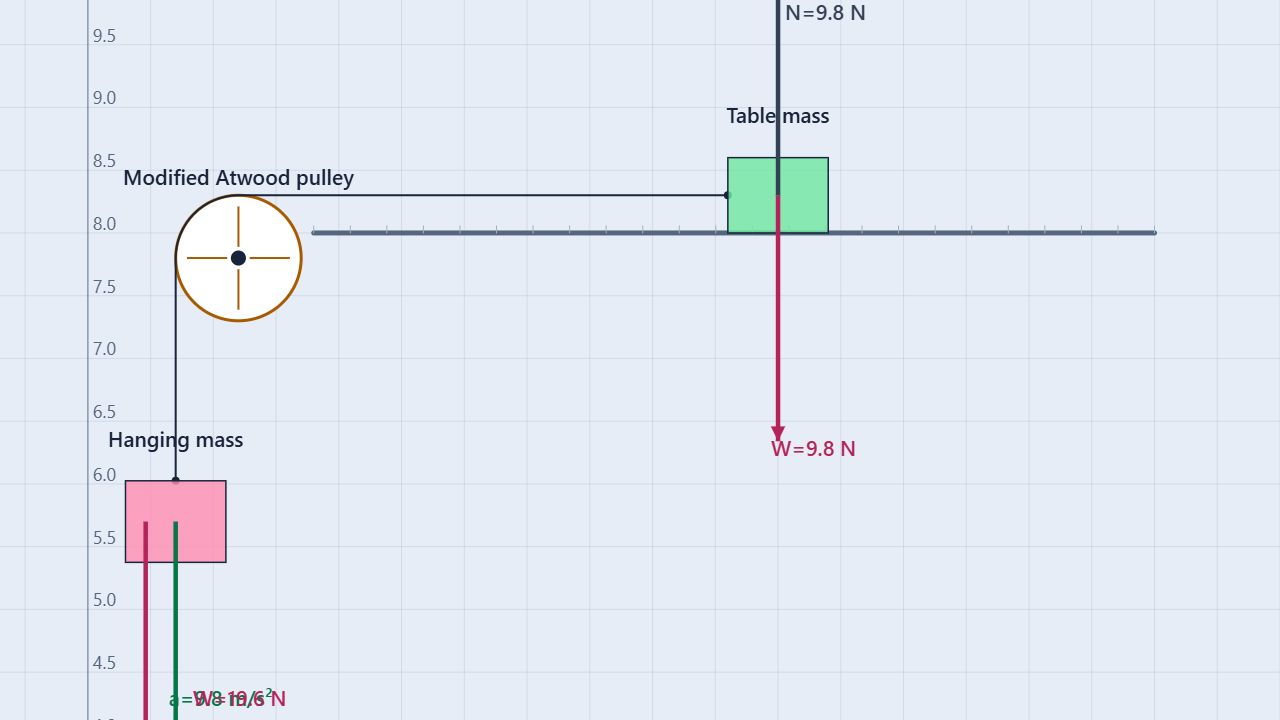
The prepared scene has a 2 kg Hanging mass connected to a 1 kg Table mass by a string over a pulley with its mass disabled. The table is horizontal. For this investigation, disable friction in World and keep gravity downward at 9.80 m/s².
Change
Table mass: 1, 2, 3, 4, and 5 kg.
Keep fixed
Hanging mass at 2 kg, the original positions, zero initial velocity, string and pulley geometry, and friction disabled.
The hanging weight stays at 19.60 N while the total moving mass increases. Predict whether acceleration and string tension will increase or decrease before running.
Build the model
Write one equation for each mass
Take positive motion toward the pulley for the table block and downward for the hanging mass. With a taut, massless, inextensible string over an ideal pulley, the acceleration magnitudes are equal and tension has the same magnitude on both sides.
Table block: T = mta
Hanging mass: mhg − T = mha
Adding these scalar equations eliminates tension:
a = mhg/(mh + mt)
T = mta = mh(g − a)
The table block’s weight is balanced vertically by the table’s normal force. It adds inertia without contributing a gravitational pull along its horizontal path.
Procedure
A useful five-trial workflow
- Load and inspect. Launch the simulation and choose Modified Atwood machine if a saved scene appears. Disable friction in World. Keep the pulley’s mass disabled.
- Set the masses. Open Properties and select Hanging mass to confirm 2 kg. Select Table mass and set it to 1 kg. Keep both initial velocities zero and the string taut.
- Predict and run. Calculate acceleration and tension. Set the run duration beside Play to 0.5 seconds. Run only while the table block is clear of the pulley and both objects move freely.
- Collect evidence. Open the Data panel. Select an object and choose acceleration magnitude and tension as graph measurements. Record a sample after motion begins, including its time. Compare both objects at the same time; their acceleration magnitudes should be approximately equal.
- Reset and repeat. Reset before changing Table mass to 2, 3, 4, and 5 kg. Keep Hanging mass at 2 kg and restore the same starting conditions. Export CSV to compare the trials.
| Table mass (kg) | Total mass (kg) | Acceleration (m/s²) | Tension (N) |
|---|---|---|---|
| 1 | 3 | 6.533 | 6.533 |
| 2 | 4 | 4.900 | 9.800 |
| 3 | 5 | 3.920 | 11.760 |
| 4 | 6 | 3.267 | 13.067 |
| 5 | 7 | 2.800 | 14.000 |
Acceleration decreases while tension increases. The more slowly the hanging mass accelerates downward, the closer its upward tension comes to balancing its weight.
Worked example
Check the prepared 2 kg and 1 kg pair
a = (2.00 × 9.80)/(2.00 + 1.00) ≈ 6.533 m/s²
T = 1.00 × 6.533 ≈ 6.533 N
The hanging mass provides a second check: T = 2.00(9.80 − 6.533) ≈ 6.533 N, allowing for rounding. Starting from rest, the ideal speed at 0.500 s is about 3.267 m/s and the distance each mass travels along its path is about 0.817 m.
Why are the graph components negative?
In this scene the table block moves left and the hanging mass moves down. With the simulation’s rightward x and upward y axes, the table block has negative x acceleration and the hanging mass has negative y acceleration. Compare magnitudes when checking their shared acceleration.
Common misconception
Is tension equal to the hanging weight?
Only when the hanging mass has zero vertical acceleration. Here it accelerates downward, so tension is less than its weight.
Why not divide by just the hanging mass?
Both objects accelerate. Using only the hanging mass ignores the inertia of the table block and incorrectly predicts free-fall acceleration.
Do equal masses balance?
No. Unlike a standard Atwood machine, only one mass hangs. Two equal masses in this frictionless setup accelerate at g/2.
For teachers
Separate the driving force from total inertia
Plot acceleration against reciprocal total mass, 1/(mₕ + mₜ). With hanging mass fixed, the ideal slope is mₕg = 19.60 N. Ask students to explain why a graph against table mass itself is curved.
Add friction as a second investigation
For a table block already sliding toward the pulley, kinetic friction opposes motion: a = (mₕg − μₖmₜg)/(mₕ + mₜ). Before release, static friction can hold the system at rest when mₕg ≤ μₛmₜg. Do not use the kinetic equation to decide whether motion begins. Check the actual block–table contact coefficients and overrides when enabling friction.
Compare with the Atwood Machine, where both weights contribute along the string, and the Newton’s Second Law experiment. Physics reference: OpenStax, University Physics Volume 1, §6.1. Learn about the educator behind the simulations on the BuildPhysics About page.