
Plan the investigation
Does twice the speed require twice the force?
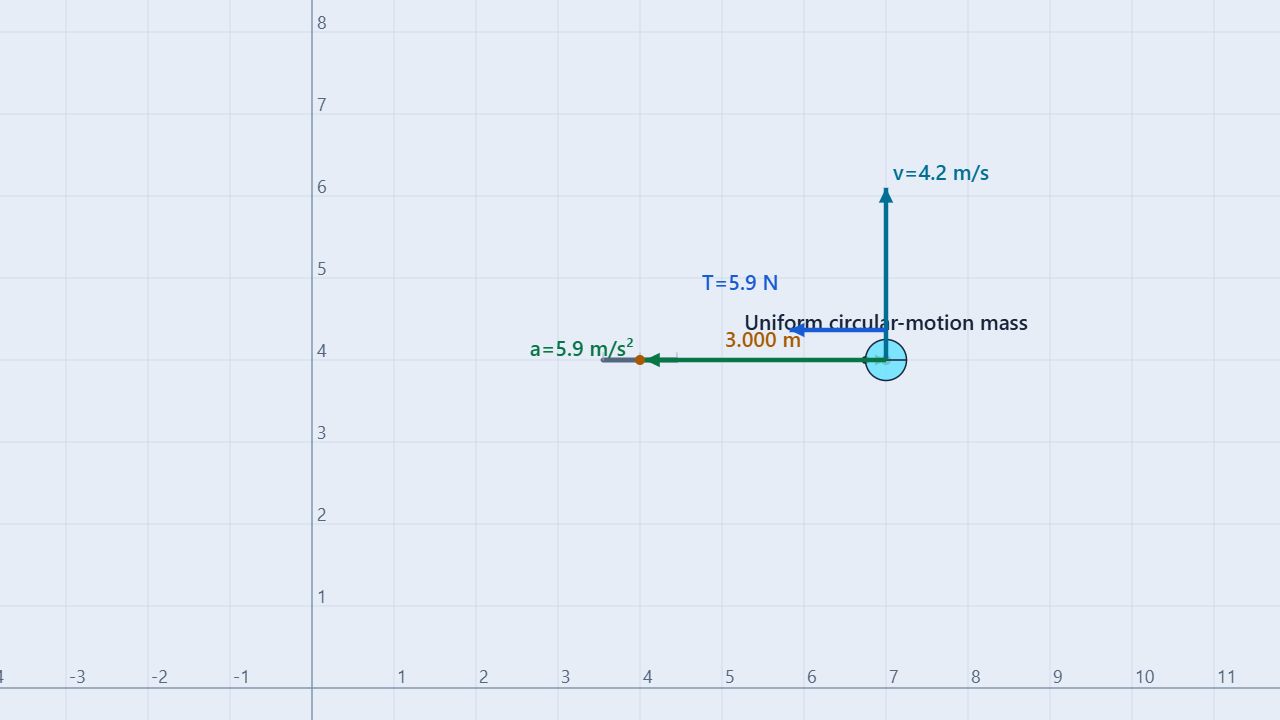
The prepared scene starts with a 1 kg mass, a 3 m string, and a tangential speed of 4.2 m/s. The mass begins to the right of the pivot, moving upward on screen. Gravity and friction are disabled so the scene isolates motion in a plane without a downward gravitational force.
Change
Initial tangential speed: 2, 3, 4, 5, and 6 m/s.
Keep fixed
Mass at 1 kg, radius at 3 m, the pivot and starting position, zero gravity, and friction disabled.
The string supplies the inward force. It must remain taut for the circular-motion model to apply. This is a model of motion in a horizontal plane; it does not include the changing gravitational contribution found in a vertical loop.
Build the model
Velocity is tangent; acceleration points inward
At every point, velocity follows the tangent to the circle while acceleration points toward the pivot. The string’s tension changes the direction of motion. For this setup, tension is the only force on the moving mass:
ac = v²/r
Ftension = mac = mv²/r
One revolution covers 2πr, so the period is P = 2πr/v. Here P denotes period in seconds, keeping it distinct from string tension in newtons.
Procedure
A useful five-trial workflow
- Load and inspect. Launch the simulation. If a saved scene appears, choose Uniform circular motion. Keep gravity at zero and friction disabled in World.
- Set the velocity. Open Properties and select Uniform circular-motion mass. Keep Mass at 1 kg. At the original starting position, set the initial x velocity to 0 and y velocity to +2 m/s. This points tangent to the circle.
- Predict and run. Calculate acceleration, tension, and period before pressing Play. Set a 2-second run duration beside Play for the force comparison.
- Read the data. With the mass selected, open the Data panel. The preset graphs tension, acceleration magnitude, and speed. Record a sample time and all three values after motion starts. Use measured speed in v²/r when checking a sampled acceleration.
- Reset and repeat. Reset before setting y velocity to +3, +4, +5, and +6 m/s. Keep x velocity zero and restore the original position. Export CSV to compare the trials. Plot tension against speed squared.
| Speed (m/s) | Acceleration (m/s²) | Tension (N) | Period (s) |
|---|---|---|---|
| 2.00 | 1.333 | 1.333 | 9.425 |
| 3.00 | 3.000 | 3.000 | 6.283 |
| 4.00 | 5.333 | 5.333 | 4.712 |
| 5.00 | 8.333 | 8.333 | 3.770 |
| 6.00 | 12.000 | 12.000 | 3.142 |
The 2-second runs compare force and acceleration; they are too short for a complete revolution at these speeds. To measure period, run a separate longer trial and time successive returns to the same position moving in the same direction. Average several revolutions when practical.
Worked example
Check the prepared 4.2 m/s scene
For the original 1 kg mass and 3 m radius:
ac = 4.2²/3 = 5.88 m/s²
Ftension = 1 × 5.88 = 5.88 N
P = 2π(3)/4.2 ≈ 4.488 s
Compare the 3 m/s and 6 m/s trials in the table: doubling speed quadruples tension from 3 N to 12 N and halves the period. Acceleration and tension have equal numerical values here only because mass is 1 kg; their units and meanings differ.
Why do x and y components change?
The inward direction rotates with the mass. Horizontal and vertical acceleration components therefore change even when acceleration magnitude is constant. At the original rightmost position, inward means left: the ideal initial acceleration is ax = −5.88 m/s² and ay = 0.
Common misconception
Is centripetal force an extra force?
No. “Centripetal” describes the inward role of the net force. In this experiment, tension supplies that force. Do not add a separate centripetal-force arrow to tension when summing forces.
Does constant speed mean no acceleration?
Acceleration measures a change in velocity, including direction. The speed can stay constant while the velocity turns.
What if the string is released?
With gravity and other forces absent, the mass continues along the tangent with its velocity at release. It does not fly directly away from the center.
Why might the result differ from the table?
Check that gravity remains zero, the initial velocity is tangent, the radius is 3 m, and the string stays taut. Use an actual sampled speed when evaluating v²/r. Numerical integration can produce small changes over time, so compare samples from the same stage of each run.
For teachers
Use a graph to reveal the squared relationship
A tension-versus-speed graph curves upward. Plotting tension vertically against speed squared horizontally should instead give a line through the origin with slope m/r = 0.333 kg/m. Ask students to support the relationship with ratios as well as a graph.
For a second investigation, double mass at fixed speed and radius: tension should double while acceleration stays the same. When investigating radius, specify what stays fixed. At fixed speed, a larger radius requires less force; at fixed angular speed, F = mrω² predicts more force.
Continue with Vertical Circular Motion to investigate gravity’s effect, or revisit the Newton’s Second Law experiment to connect force, mass, and acceleration.
Physics reference: OpenStax, University Physics Volume 1, §6.3. Learn about the educator behind these simulations on the BuildPhysics About page.