
Plan the investigation
How steep is too steep?
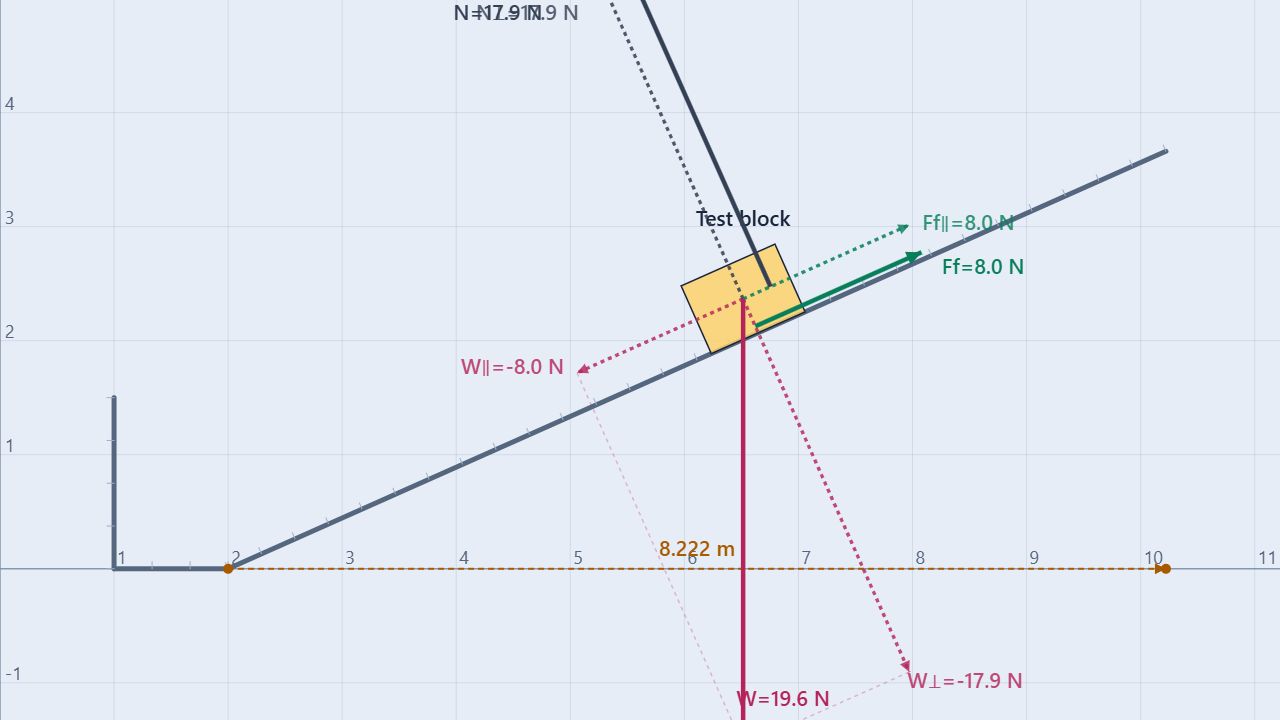
The prepared scene has a 2 kg Test block on a 9 m Adjustable rough incline at 24°. Both the block and ramp start with static coefficient μs = 0.50 and kinetic coefficient μk = 0.35. Friction is enabled. Leave these coefficients unchanged for the first investigation.
Change
Ramp angle: begin with 24°, 26°, 26.5°, 27°, and 28°.
Keep fixed
Mass, friction coefficients, gravity at 9.80 m/s², and the starting position along the ramp. Start each trial from rest.
The goal is to bracket the onset of sustained sliding. Record the largest tested angle that holds the block and the smallest tested angle that makes it slide. A finite set of trials gives an interval, not an exact threshold.
Build the model
Static friction adjusts to the demand
Weight acts downward, normal force acts perpendicular to the ramp, and friction opposes the tendency to slip downhill. With no other forces and no motion perpendicular to the ramp:
N = mg cos θ
At rest: fs = mg sin θ, provided fs ≤ μsN
At the limiting angle, the required uphill friction reaches its maximum:
mg sin θc = μsmg cos θc
μs = tan θc
Mass cancels. A heavier block requires more friction to hold, but its larger normal force also increases the available static friction in the same proportion.
Procedure
A useful five-trial workflow
- Load and inspect. Launch the simulation and choose Critical-angle friction if a saved scene appears. Keep friction enabled. Open Properties and select Adjustable rough incline.
- Set the angle. Edit Angle in the ramp’s Properties, using degrees. Keep Length at 9 m. Check that Test block rests on the straight ramp, clear of its ends; reposition it on the surface if needed.
- Start from rest. Select Test block and confirm zero initial velocity. Set a 1-second run duration beside Play. Run and observe whether speed remains near zero or grows persistently downhill.
- Record the outcome. With Test block selected, use the Data panel’s speed graph and sampled values. Record the angle, observation time, speed, and whether sustained sliding occurred. Ignore a momentary settling movement; stop before an impact or a change of surface.
- Reset and refine. Reset before entering the next angle. Complete the five trials, then test smaller angle steps between the last resting case and first sliding case. Restore the same starting conditions each time.
| Angle | tan θ | Predicted outcome |
|---|---|---|
| 24° | 0.4452 | Can remain at rest |
| 26° | 0.4877 | Can remain at rest |
| 26.5° | 0.4986 | Can remain at rest |
| 27° | 0.5095 | Slides downhill |
| 28° | 0.5317 | Slides downhill |
If your observations match this table, the threshold lies between 26.5° and 27°. That brackets μs between approximately 0.4986 and 0.5095. Near the boundary, numerical tolerances and a small initial motion can affect a trial; report your angle resolution rather than claiming more precision than you tested.
Worked example
Predict the threshold and the motion after slipping
For the prepared coefficient:
θc = arctan(0.50) ≈ 26.565°
At 24°, the 2 kg block requires about 7.972 N of uphill friction. Its normal force is about 17.905 N, giving a maximum static friction of 8.953 N. The required friction is below that limit, so the block can stay at rest.
At 28°, static friction cannot hold it. Once it is sliding downhill, use the kinetic coefficient, 0.35, and take downhill as positive:
a∥ = g(sin θ − μk cos θ)
= 9.80(sin 28° − 0.35 cos 28°)
≈ 1.572 m/s² downhill
This acceleration applies during sliding on the straight ramp. Do not use the kinetic-friction equation to decide whether a stationary block starts moving; first test the static-friction limit.
Common misconception
Is static friction always μsN?
No. μsN is the maximum available static friction. Below the threshold, the actual friction only needs to balance the downhill component of weight.
Does a moving block stop below the critical angle?
Not necessarily. The critical angle describes release from rest. With μk = 0.35, a block already sliding downhill at 24° can keep speeding up even though a stationary block at that angle can remain at rest.
Does doubling mass lower the threshold?
Not in this ideal model. Repeat the resting and sliding cases with 4 kg to test that claim. Both the gravitational component and friction capacity double.
Why did changing World friction have little effect?
This prepared scene assigns friction values to the contact objects. Check the block and ramp settings and any contact overrides before treating a World setting as the coefficient used by that pair.
For teachers
Ask for an interval supported by evidence
Have students submit the two trials that bracket the threshold, convert both angles with tan θ, and compare their interval with the preset coefficient. Distinguish an observed boundary from the theoretical value 26.565°.
Extend the lab by testing mass independence, or by comparing release from rest with a small downhill initial velocity at 24°. Keep coefficients fixed so the comparison isolates static versus kinetic behavior.
Continue with the Inclined Plane experiment for the frictionless comparison, or review Static and Kinetic Friction and Inclined Planes.
Physics reference: OpenStax, University Physics Volume 1, §6.2. Learn about the educator behind the simulations on the BuildPhysics About page.