
Plan the investigation
What students will do
Use the student handout to organize predictions, measurements, and explanations.
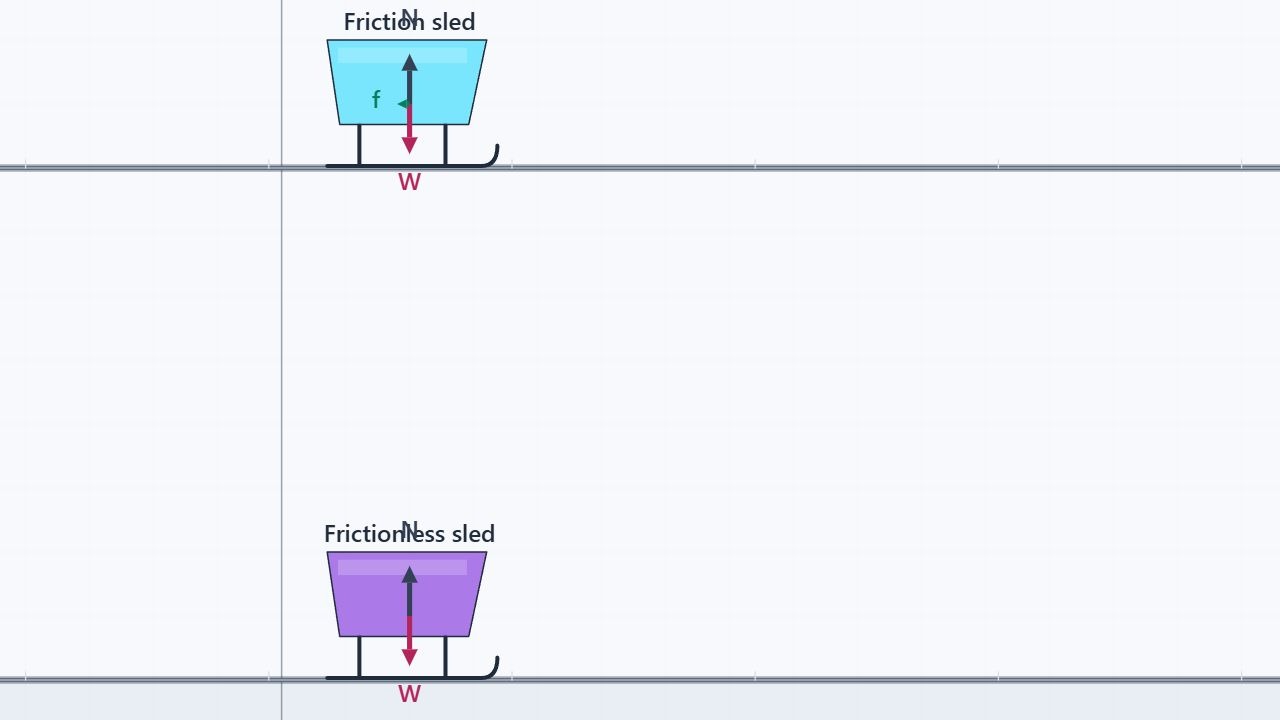
- Predict both motions. Identify the horizontal forces on a rough-track sled and a frictionless sled with matching initial velocities.
- Compare velocity traces. Run both sleds and use live values and graphs to compare velocity and acceleration.
- Balance friction. Adjust the forward force on the rough-track sled until its velocity stays close to the coasting sled’s velocity.
- Explain and retest. Use force balance to estimate kinetic friction, then predict and test the matched force at a lower starting speed.
What students will learn
- Distinguish zero acceleration from zero velocity.
- Explain constant velocity through balanced forces.
- Use a matched-motion trial to estimate a friction coefficient.
Common misconception
Does continued motion require a forward net force?
Students compare coasting and balanced-force motion to explain what changes velocity.