
Plan the investigation
Analyze the impact and swing as separate stages
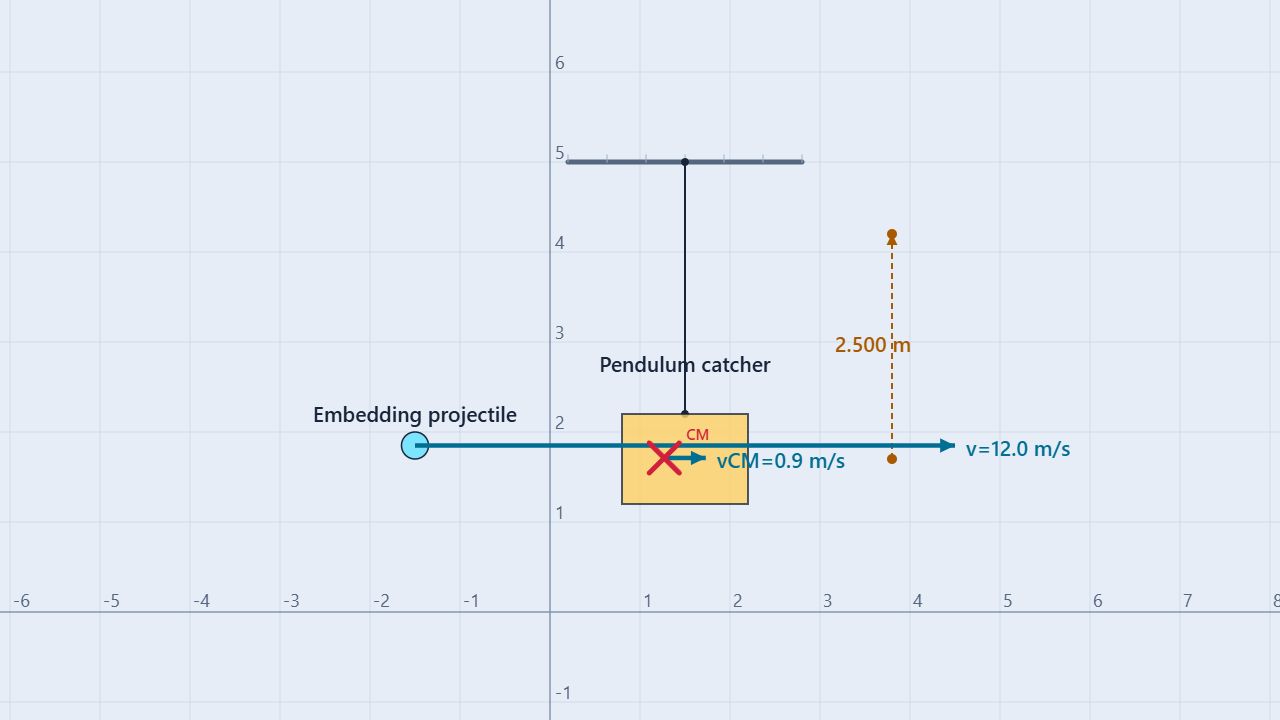
The prepared scene uses a 0.250 kg projectile launched at 12.0 m/s toward a 3.00 kg pendulum catcher. The catcher begins at about y = 1.70 m, and the projectile embeds in it. After the impact, the combined mass swings upward on a string. Friction is disabled, so the baseline isolates the inelastic collision and the following energy conversion.
Change one variable
Change projectile speed, projectile mass, or catcher mass while holding the other two fixed. Reset between trials so each collision starts from the same geometry.
Measure both stages
Record projectile speed just before impact, combined speed just after capture, and the catcher’s maximum center-of-mass rise. The Data panel can show momentum, kinetic energy, and gravitational potential energy.
The impact is perfectly inelastic: the projectile and catcher move together after contact. Mechanical energy is not conserved through that brief impact, but momentum is the intended approximation. During the later swing, the combined mass trades kinetic energy for gravitational potential energy.
Build the model
Use momentum first, then energy
Let m be the projectile mass, M the catcher mass, vi the projectile’s incoming speed, and V the speed immediately after capture. The catcher starts at rest:
m vi + M(0) = (m + M)V
V = m vi/(m + M)
Once the two objects move together, use the combined mass for the swing. If the center of mass rises by Δh before the turning point:
½(m + M)V² = (m + M)gΔh
V = √(2gΔh)
Combining the two stages gives the launch-speed equation:
vi = (m + M)/m √(2gΔh)
Notice what cancels in the swing equation: the combined mass. Mass still matters when reconstructing launch speed because the inelastic collision shares the projectile’s momentum with the catcher.
Procedure
Work backward from the maximum rise
- Load and inspect. Open Ballistic Pendulum and select the catcher. Verify projectile mass, catcher mass, initial projectile velocity, downward gravity at 9.80 m/s², and friction disabled.
- Record the launch. Write down m, M, and the projectile’s initial horizontal speed. Calculate the incoming momentum pi = mvi.
- Identify capture. Run until the projectile embeds in the catcher. Pause just after the impact and record the combined speed. Do not use the catcher’s later turning-point speed for the momentum equation.
- Measure the swing. Continue the run until the catcher reaches its first maximum rise. Record the initial combined center height and the maximum center height, then calculate Δh.
- Reconstruct the launch. Use Δh in the swing equation to find V, then use momentum conservation to calculate vi. Compare the result with the preset’s 12.0 m/s starting value.
- Compare trials. Reset and change one mass or the projectile speed. Export the data and report the measured values, calculated values, and percent difference separately.
| Quantity | Calculation | Prediction |
|---|---|---|
| Incoming momentum | (0.250)(12.0) | 3.00 kg·m/s |
| Combined mass | 0.250 + 3.00 | 3.250 kg |
| Speed after capture | 3.00 / 3.250 | 0.923 m/s |
| Maximum center-height rise | 0.923²/(2 × 9.80) | 0.0435 m |
| Projectile kinetic energy before impact | ½(0.250)(12.0)² | 18.0 J |
| Combined kinetic energy after impact | ½(3.250)(0.923)² | 1.38 J |
The simulation uses finite-size bodies and resolves contact over multiple physics steps, so a sample taken a little before or after the exact impact can differ from the ideal row. Use the time and state shown in the Data panel to explain the discrepancy.
Worked example
Recover a 12.0 m/s launch from the rise
Suppose the combined pendulum rises 0.0435 m from its post-impact center height. First recover the speed immediately after capture:
V = √(2 × 9.80 × 0.0435) ≈ 0.923 m/s
Then use the masses to undo the momentum sharing:
vi = (0.250 + 3.00)/0.250 × 0.923
vi ≈ 12.0 m/s
The projectile’s initial kinetic energy was 18.0 J, while only about 1.38 J remains as the combined kinetic energy immediately after capture. The missing mechanical energy was converted mainly into deformation, sound, and thermal energy during the inelastic impact.
Compare trials
See how mass changes the inference
For the same 12.0 m/s projectile and 3.00 kg catcher, a heavier projectile transfers more momentum and produces a larger post-impact rise. These ideal rows help plan trials.
| Projectile mass (kg) | Post-impact speed (m/s) | Rise (m) | Launch-speed recovery |
|---|---|---|---|
| 0.125 | 0.480 | 0.0118 | 12.0 m/s |
| 0.250 | 0.923 | 0.0435 | 12.0 m/s |
| 0.500 | 1.714 | 0.1499 | 12.0 m/s |
| 1.000 | 3.000 | 0.4592 | 12.0 m/s |
With a fixed launch speed, the recovered value should remain 12.0 m/s in the ideal model even though the rise changes. A larger rise is easier to resolve experimentally, but changing projectile mass also changes the collision’s energy loss, so do not compare rise alone without using the mass values.
Interpret the evidence
Look for the break between collision and swing
Momentum is the best diagnostic across the short impact: compare the projectile-plus-catcher momentum immediately before and after capture. Mechanical energy should show a sharp drop at that instant. During the swing, momentum is not constant because the string and gravity exert external forces, while the combined mechanical energy should remain approximately constant if friction is off.
Plot height and speed together. The post-impact speed is largest at the beginning of the swing and approaches zero at the first maximum rise. Use the measured center height rather than the top edge of the catcher when calculating Δh.
Common misconceptions
Check the reasoning
Is mechanical energy conserved during the collision?
No. The projectile embeds in the catcher, so the impact is inelastic. Momentum is the useful conserved quantity for the short collision model.
Is momentum conserved during the entire swing?
No. The string’s tension and gravity provide external forces for the projectile-plus-catcher system. Use mechanical energy for the ideal swing instead.
Can I use the projectile mass alone in the swing equation?
No. After capture, the moving object is the combined mass m + M. The mass cancels from the ideal speed-rise relation, but it must be included when reconstructing the launch speed from momentum.
Does maximum height mean the speed is zero everywhere?
No. Speed is momentarily zero at the turning point only. It is largest immediately after the impact and decreases as the combined mass rises.
For teachers
Make the two conservation laws visible
Ask students to draw a timeline with three snapshots: just before impact, just after capture, and at maximum rise. Require a separate system boundary and conservation statement for each interval. This prevents them from applying one conservation law across the entire event.
Have groups vary projectile mass while keeping its speed fixed, then compare post-impact speed, rise, and recovered launch speed. A second extension changes catcher mass. Review Newton’s Third Law, Conservation of Energy, and One-Dimensional Collision.
Physics reference: OpenStax, Physics, collisions. Learn about the educator behind the simulations on the BuildPhysics About page.