
Plan the investigation
Does a heavier bob swing more slowly?
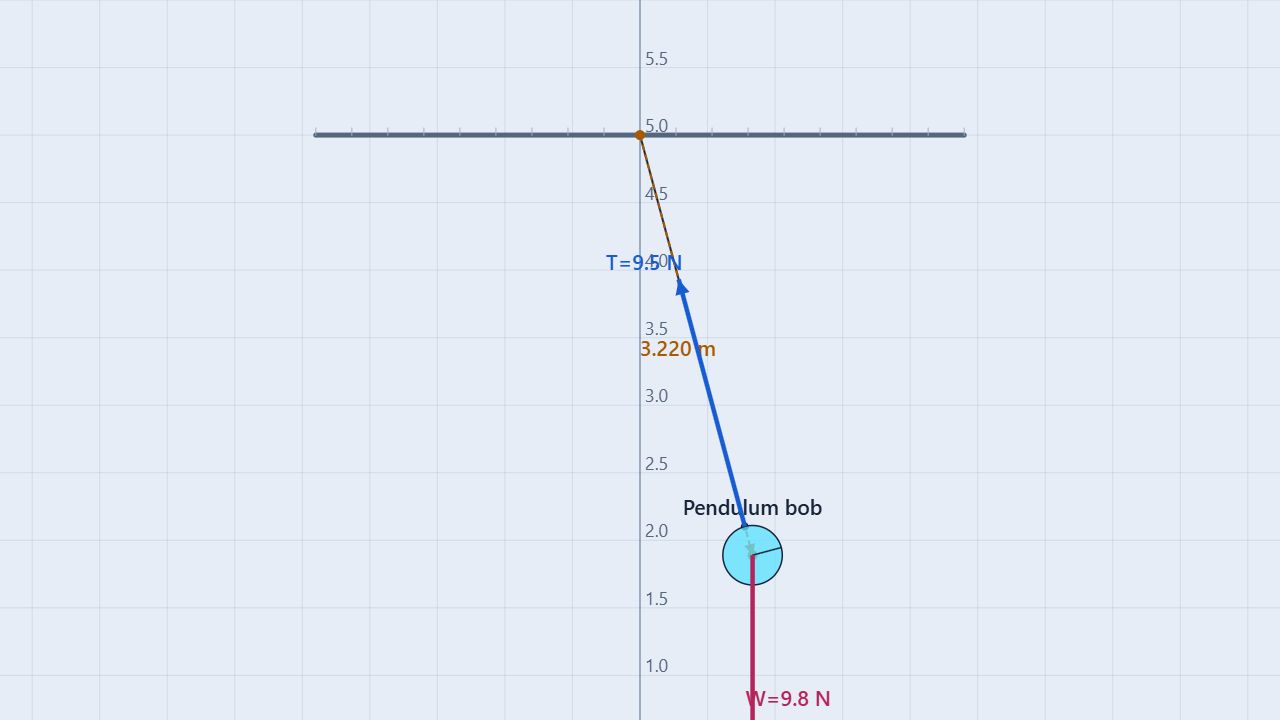
The prepared scene releases a 1 kg bob from rest at 15° from vertical. Gravity acts downward; friction and drag are disabled. Change only mass for the first five trials.
Change
Bob mass: 1, 2, 3, 4, and 5 kg.
Keep fixed
String length, bob radius, release angle and position, zero initial velocity, and gravity at 9.80 m/s².
Measure length to the bob’s center. The preset’s 3 m string attaches at the edge of a bob with radius 0.22 m. The initial pivot-to-center distance is 3.22 m. Substituting 3 m into a point-mass formula would describe a different geometry.
Build the model
What the small-angle equation predicts
Gravity provides the restoring tendency toward the lowest point. For a point mass on a massless, inextensible string, the small-angle approximation gives:
T ≈ 2π√(L/g)
Measured period: T = (tend − tstart)/N
Here L is the pivot-to-point-mass distance and N is the number of complete cycles between the two times. The equation assumes small oscillations, a fixed pivot, and negligible losses. The simulation uses a finite bob that can rotate, so treat a point-mass calculation as a comparison model rather than an exact solver result.
Procedure
A useful five-trial workflow
- Load the scene. Launch the simulation and choose Period of a pendulum if a saved scene appears. Keep the prepared geometry and 15° release position.
- Set mass. Open Properties and select Pendulum bob. Set Mass to 1 kg. Keep its radius at 0.22 m and initial velocity zero. Confirm gravity is downward at 9.80 m/s², with drag and friction disabled.
- Run and record. Set a 25-second run duration beside Play. With the bob selected, open the Data panel; the preset graphs horizontal position and horizontal velocity.
- Time five complete cycles. Identify a crossing of x = 0 with positive horizontal velocity. Find the sixth crossing in that same direction. Five full cycles separate those events. Record both times and divide their difference by five. Export CSV for closer inspection.
- Reset and repeat. Reset before changing mass to 2, 3, 4, and 5 kg. Restore the same release conditions. Compare measured periods and the resolution of your timing before deciding whether any differences are meaningful.
| Mass (kg) | Period (s) | Five cycles (s) |
|---|---|---|
| 1 | 3.602 | 18.008 |
| 2 | 3.602 | 18.008 |
| 3 | 3.602 | 18.008 |
| 4 | 3.602 | 18.008 |
| 5 | 3.602 | 18.008 |
A sample may fall on either side of x = 0. Use the same crossing rule in every trial, or interpolate between the two neighboring samples. Timing multiple cycles reduces the effect of endpoint timing uncertainty.
Worked example
Calculate a period and check a timing result
T ≈ 2π√(3.22/9.80) ≈ 3.602 s
For an illustrative timing example, suppose five cycles take 18.10 s. The measured period would be 18.10/5 = 3.620 s. That example is invented to demonstrate the calculation; it is not a reading from the simulation.
The 15° release is close to the small-angle regime, but the approximation is not exact. For an ideal point pendulum, the leading amplitude correction increases the period by about θ₀²/16, with θ₀ in radians: approximately 0.43% at 15°. Bob geometry and numerical integration are separate possible sources of a difference from the benchmark.
Common misconception
Is a trip from left to right one period?
No. Opposite turning points are half a cycle apart. Return to the same position moving in the same direction to measure a complete cycle.
Does greater weight imply a shorter period?
A heavier bob experiences a greater gravitational force but also has greater inertia. Mass cancels in the ideal pendulum equation. Keep geometry fixed when testing this.
Is period independent of release angle?
Only approximately at small angles. Larger swings take longer in the ideal pendulum model. Do not interpret the small-angle equation as an exact prediction at every amplitude.
Should I use the vertical-position graph?
Horizontal position is easier for counting full swings. The bob reaches the same height on both sides, so a height graph repeats twice per full back-and-forth cycle.
For teachers
Extend the investigation to length
After testing mass, compare different lengths while holding mass and release angle fixed. Reset before editing the string and reposition the bob so it begins at rest with the string taut. Measure the actual pivot-to-center distance for each setup, including the bob radius; changing string length alone can leave an unsuitable starting geometry.
Plot measured T² against pivot-to-center length. The point-mass, small-angle model predicts a straight line with slope 4π²/g ≈ 4.03 s²/m. Doubling length predicts a period larger by √2; quadrupling length predicts twice the period. Check the assumptions before using that slope to estimate gravity.
Compare this repeating swing with the complete loops in Vertical Circular Motion, and review Conservation of Mechanical Energy to explain why speed is largest near the bottom.
Physics reference: OpenStax, University Physics Volume 1, §15.4. Learn about the educator behind these simulations on the BuildPhysics About page.