
Plan the investigation
Compare a disk and hoop from the same height
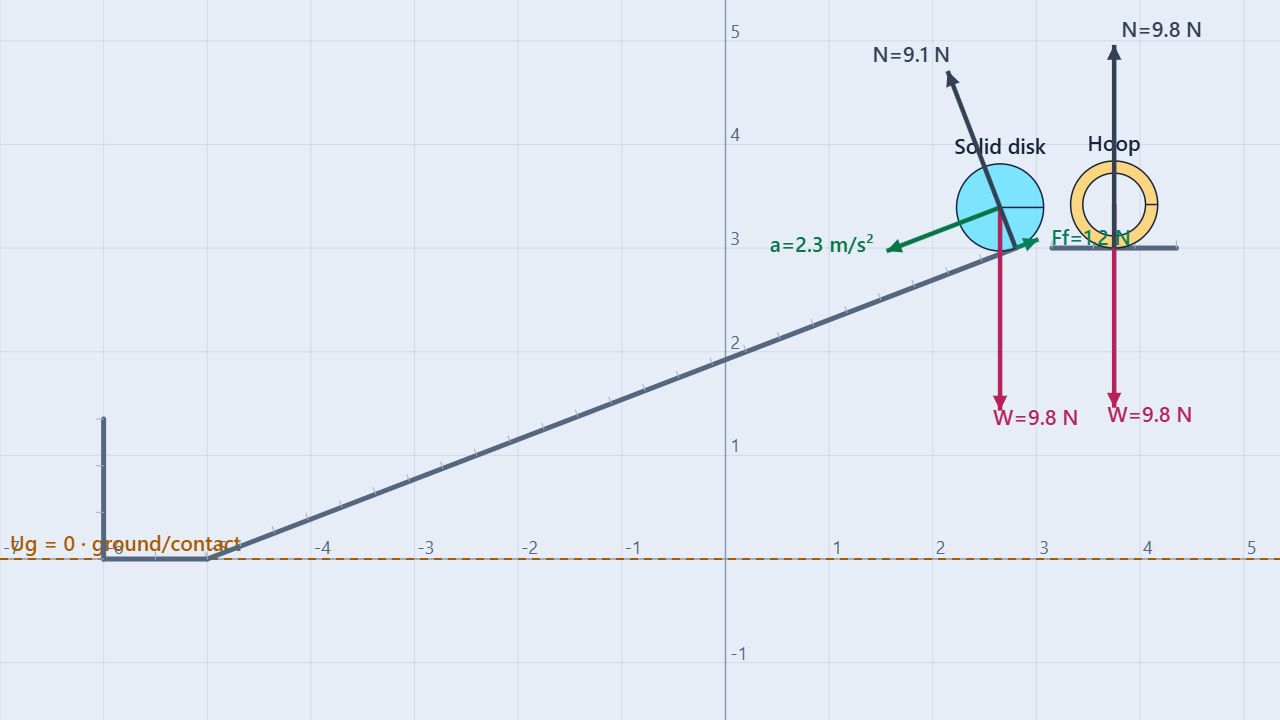
The prepared scene includes a 1.00 kg solid disk and a 1.00 kg thin hoop, each with radius 0.42 m. The ramp rises about 3.00 m from the lower floor to its upper end. The disk starts at the top of the ramp; the hoop starts on a same-height staging platform so you can move it to the same release point before a direct comparison.
Keep fixed
Mass, radius, release height, release speed, ramp shape, and rolling-without-slipping conditions.
Change one variable
Change object shape or inertia factor for a shape trial, or change the release height for an energy-scaling trial.
Static friction supplies the torque needed for rolling without slipping. In the ideal model it does no net work, so total mechanical energy stays constant even though energy moves between gravitational, translational, and rotational forms.
Build the model
Separate translation from rotation
For rolling without slipping, the center-of-mass speed and angular speed are linked:
v = Rω
Use I = kMR² to represent the mass distribution. A solid disk has k = 0.50; a thin hoop has k = 1.00. Starting from rest, conservation of mechanical energy gives:
Mgh = ½Mv² + ½Iω²
Mgh = ½Mv²(1 + k)
v = √(2gh/(1 + k))
The ideal acceleration down a straight incline at angle θ is:
a = g sinθ/(1 + k)
For the same height drop, the hoop has the larger k, so more of the available energy goes into rotation and less into center-of-mass translation. That makes its final linear speed smaller.
Procedure
Measure speed, timing, and energy
- Load and inspect. Open Rolling Objects and record each object’s mass, radius, shape, and inertia factor. Confirm gravity and rolling friction settings.
- Make the release fair. Move the hoop from the staging platform to the top of the same ramp. Place both objects at the same height with zero linear and angular velocity.
- Predict before running. Use v = √(2gh/(1+k)) to predict the bottom speed. Also predict ω = v/R and the relative arrival time from the ramp length.
- Run one object at a time. Reset between trials. Record arrival time, bottom speed, angular speed, translational kinetic energy, rotational kinetic energy, and total mechanical energy.
- Check rolling and energy. Test whether v ≈ Rω and whether Ktrans + Krot + Ug remains approximately constant.
- Change one setting. Repeat with the other shape, then run a height trial while holding shape, mass, radius, and track conditions fixed.
| Object | Inertia factor k | Bottom speed v | Bottom angular speed ω | Energy split at bottom |
|---|---|---|---|---|
| Solid disk | 0.50 | 6.26 m/s | 14.9 rad/s | 66.7% translational; 33.3% rotational |
| Thin hoop | 1.00 | 5.42 m/s | 12.9 rad/s | 50.0% translational; 50.0% rotational |
The exact height and track distance should be measured from the simulation’s rulers. Numerical friction, contact corrections, and rounded readings can make measured values differ from the ideal rows.
Worked example
Why the disk reaches the bottom faster
For the solid disk, k = 0.50, so the ideal energy prediction for a 3.00 m drop is:
vdisk = √(2(9.80)(3.00)/(1 + 0.50)) = 6.26 m/s
ωdisk = 6.26/0.42 = 14.9 rad/s
For the hoop, k = 1.00:
vhoop = √(2(9.80)(3.00)/(1 + 1.00)) = 5.42 m/s
ωhoop = 5.42/0.42 = 12.9 rad/s
Both objects lose the same gravitational potential energy, but they divide the energy differently. The hoop puts half of the total into rotation; the disk puts only one third into rotation, leaving more for translational motion.
Compare trials
Change the inertia factor
Keep mass, radius, and height fixed while changing only k. The final-speed relationship is an inverse square-root relationship, not a claim that the object’s mass changes.
| Inertia factor k | Object model | Bottom speed (m/s) | Rotational energy fraction |
|---|---|---|---|
| 0.00 | Point-mass limit | 7.67 | 0% |
| 0.50 | Solid disk | 6.26 | 33.3% |
| 1.00 | Thin hoop | 5.42 | 50.0% |
| 2.00 | Large-inertia model | 4.43 | 66.7% |
For a height trial, hold k fixed and test whether bottom speed scales with √h. A doubled height should increase ideal speed by a factor of √2, not by a factor of two.
Interpret the evidence
Use speed and energy graphs together
On the ramp, the speed graph should rise as gravitational potential energy falls. The rotational kinetic-energy fraction should be larger for the hoop. At the same height, check that the rolling constraint and total mechanical energy agree with the model.
Ktrans = ½Mv²
Krot = ½Iω²
Rroll = v − Rω
RE = Mgh − Ktrans − Krot
Small residuals support rolling without slipping and energy conservation. A large residual may indicate that the object has slipped, the sample was taken during a contact correction, or the release heights were not actually equal.
Common misconceptions
Check the reasoning
Does the heavier object always win the race?
Not in this comparison. The disk and hoop have equal mass. Their different arrival times come from different rotational inertia, not from weight.
Does static friction remove mechanical energy?
In ideal rolling without slipping, the contact point is instantaneously at rest, so static friction can provide the torque without doing net work. Real deformation and slipping can introduce losses.
Do equal height drops guarantee equal final speeds?
Only when the objects have the same energy partition. Different inertia factors produce different final translational speeds.
Is angular speed the same as linear speed?
No. They are related by v = Rω, so their units and meanings differ. A larger radius can give the same linear speed at a smaller angular speed.
For teachers
Make the energy split visible
Have students move the hoop to the disk’s release point before running. Require a written prediction for v, ω, and the translational-versus-rotational energy fractions before they press Run.
Use a three-object extension with k = 0.50, 1.00, and 2.00. Ask students to plot bottom speed against 1/√(1+k) and explain why the graph is linear only when height and gravity are controlled.
Review Conservation of Mechanical Energy, Work and Kinetic Energy, and Rotational Inertia Versus Angular Acceleration. Physics reference: OpenStax, University Physics Volume 1, §10.4. Learn about the educator behind the simulations on the BuildPhysics About page.