
Plan the investigation
Can one launch vector hit the target?
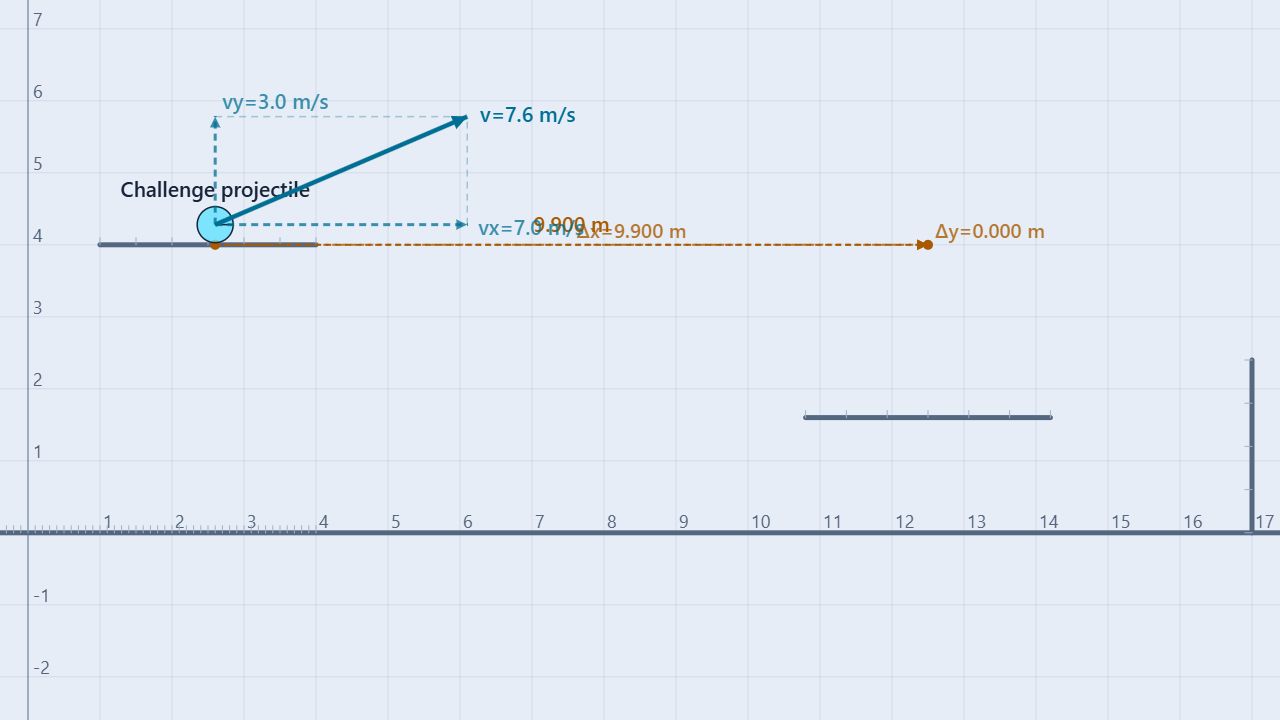
The prepared challenge starts a 1.00 kg projectile with center position x0 = 2.60 m, y0 = 4.28 m, horizontal velocity v0x = 7.00 m/s, and vertical velocity v0y = 3.00 m/s. Its radius is 0.25 m and gravity is ay = −9.80 m/s²; air resistance is off.
The launch platform is at y = 4.00 m. The raised target platform runs from x = 10.80 m to x = 14.20 m at y = 1.60 m. A successful landing occurs when the projectile center reaches the target top at y = 1.85 m while its center x-coordinate is over the platform.
Change one component
Change v0x or v0y in the projectile’s Initial conditions. Keep the starting position, radius, gravity, and target fixed while comparing trials.
Measure the landing
Record flight time, center x at target height, vertical impact velocity, and whether the ball lands on or misses the platform. Use x, y, and vy graphs to explain each result.
Use up as positive. The target is a zone, so the challenge does not have one unique answer. Your job is to predict a valid range of launch vectors and then verify it with the simulation.
Procedure
A useful five-trial workflow for targeting
- Load and identify. Launch the simulation and choose Projectile Target Challenge. Select Challenge projectile in Objects and record its position, radius, and velocity. Confirm that the target platform spans x = 10.80–14.20 m.
- Find the vertical event. Solve ytarget = y0 + v0yt − ½gt² for the positive time when the projectile center reaches ytarget = 1.85 m. This time depends on v0y, not v0x.
- Choose a horizontal component. Use xland = x0 + v0xt. A predicted xland between 10.80 m and 14.20 m should place the center over the target at the landing event.
- Run and classify. Reset, enter the trial components, and press Run. Classify the attempt as short, on target, or long. Pause near contact if you need to read the graphs and vectors.
- Repeat one change at a time. Use the table below, then change v0y while holding v0x fixed. Compare how vertical launch changes flight time and how that changes the horizontal component needed to reach the same target.
| Trial | v0x (m/s) | Flight time (s) | Predicted xland (m) | Prediction |
|---|---|---|---|---|
| Baseline | 7.00 | 1.074 | 10.118 | Short |
| 1 | 8.00 | 1.074 | 11.192 | On target |
| 2 | 9.00 | 1.074 | 12.266 | On target |
| 3 | 10.00 | 1.074 | 13.340 | On target |
| 4 | 11.00 | 1.074 | 14.414 | Long |
With v0y fixed at +3.00 m/s, the predicted target interval is approximately 7.64 ≤ v0x ≤ 10.80 m/s. The baseline 7.00 m/s launch should pass left of the platform, while the 8.00–10.00 m/s trials should land on it.
Worked example
Aim at the center of the target
For the prepared scene, the projectile center must fall from 4.28 m to 1.85 m. Let g = 9.80 m/s² and v0y = +3.00 m/s:
1.85 = 4.28 + 3.00t − 4.90t², so tland = 1.074 s
vyf = v0y − gt = 3.00 − 9.80(1.074) = −7.53 m/s
The target center is x = 12.50 m. To aim at that center:
v0x = (12.50 − 2.60)/1.074 = 9.22 m/s
That launch should land near the middle of the platform. The target still accepts a band of nearby horizontal velocities because the platform has finite width. A center position above the platform is the criterion; the projectile’s visual path can pass over the platform at other times and still miss.
Expected data pattern
Separate the vertical clock from horizontal aim
These ideal values use the center-aiming trial v0x = 9.22 m/s and v0y = 3.00 m/s. The x–t graph is linear, while the y–t graph curves downward and determines when the target height is reached.
| t (s) | x (m) | y (m) | vy (m/s) |
|---|---|---|---|
| 0.00 | 2.60 | 4.28 | +3.00 |
| 0.25 | 4.91 | 4.72 | +0.55 |
| 0.50 | 7.21 | 4.55 | −1.90 |
| 0.75 | 9.52 | 3.77 | −4.35 |
| 1.00 | 11.82 | 2.38 | −6.80 |
| 1.074 | 12.50 | 1.85 | −7.53 |
The Data panel samples at discrete times, so the row nearest contact may not equal the exact landing event. Use the target height and nearby rows to estimate the event rather than expecting a sample at exactly 1.074 s.
Common misconception
What makes a target attempt successful?
The projectile must reach the target’s top surface while its center is horizontally over the platform. Passing above the target at an earlier time is not a hit, and crossing the target’s x-range below the platform is also a miss.
Is there only one correct launch vector?
No. The target is a finite interval. With no fixed total speed or angle, many combinations of v0x and v0y can reach it.
Does increasing v0x change flight time?
No, when v0y, the starting height, and the target height stay fixed. It changes the horizontal position reached at that same vertical event.
Does a 45° launch automatically hit?
No. The 45° range result assumes a fixed launch speed and equal launch and landing heights. This challenge uses a raised target and independent velocity components.
For teachers
Turn the challenge into a model-testing lab
Require students to calculate the target-height time before they touch the controls. Have them submit a predicted interval of successful v0x values, then test the lower and upper edges and explain any difference caused by rounding or the discrete Data rows.
Extend the lab by holding v0x = 9.22 m/s and varying v0y. Students should find that a different vertical component changes flight time and therefore changes the horizontal component needed to reach the same target. Export CSV to compare x, y, and vy histories across trials.
The Projectile Motion lab develops the component equations, while the Projectile-Motion Independence lab isolates the shared vertical fall. Reference guides: Projectile Motion, Free Fall Motion, and 2D Vectors and Relative Motion.