
Plan the investigation
What students will do
Start with a guided comparison, then plan an investigation, analyze a graph, and check a prediction.
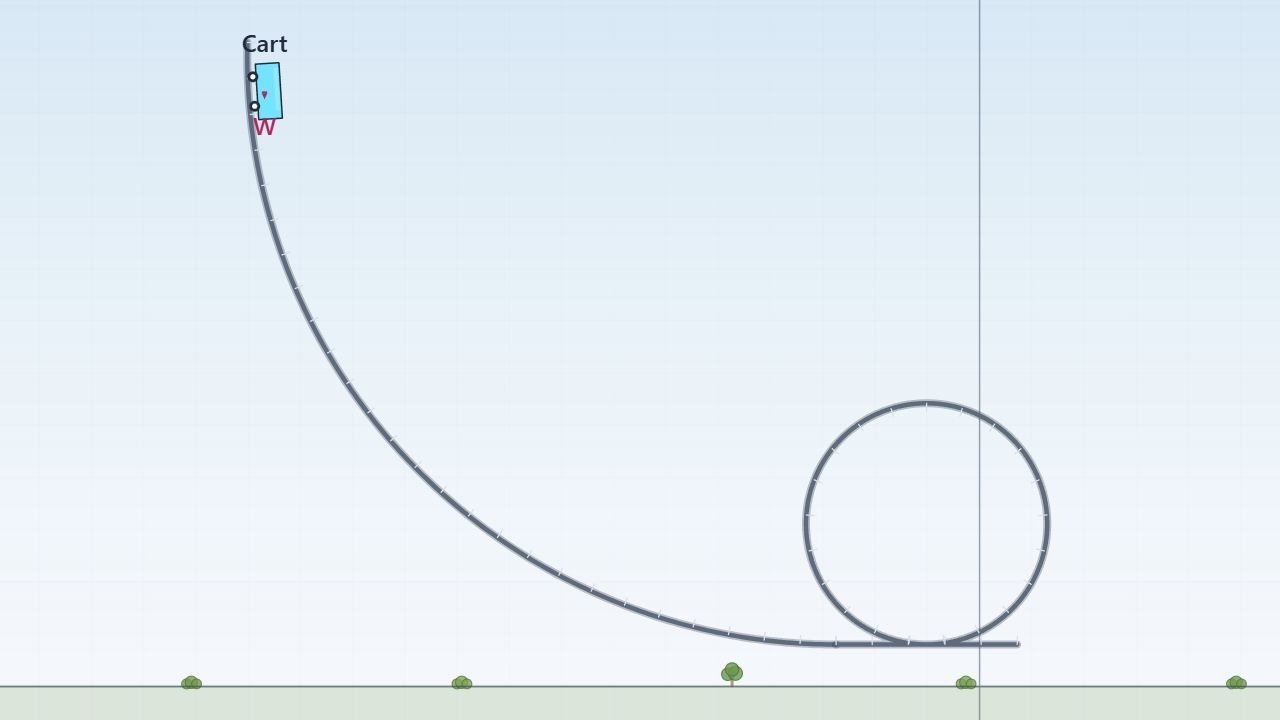
- Compare cart masses. Measure bottom speed and normal force for different masses at the same loop radius.
- Design and collect. Choose the order of the supported loop radii. Keep mass, release point, and initial speed fixed.
- Analyze a linear graph. Use inverse radius to test the bottom-force model. Interpret the fitted line alongside the measured speed.
- Explain and predict. Distinguish normal force from inward net force and use the graph to predict a supported radius before testing it.
What students will learn
- Distinguish a support force from centripetal net force.
- Control the measurement location when comparing circular-motion trials.
- Connect graph slope and intercept with speed and weight.
Common misconception
Does doubling radius halve the normal force?
Normal force supports weight as well as supplying the additional inward force at the bottom.