
Core idea
Choose the system before choosing the equation
Unit 2 problems become manageable when the same sequence is used every time: name the object or system, draw only the forces acting on it, choose axes that match the geometry, add the external-force components, and connect the net force to acceleration.
ΣF⃗external = msysa⃗
ΣFx = msysax; ΣFy = msysay
Equilibrium means the net force is zero, whether the object is at rest or moving at constant velocity. Ramps, elevators, friction, and connected masses add constraints, but they still use the same system-boundary and vector-sum framework.
One object
Include forces received by the selected object. Use its mass and acceleration in Newton’s Second Law.
One system
Internal forces disappear from the external-force sum when every object receiving those forces is inside the boundary.
Guided review path
Connect the Unit 2 ideas in a deliberate order
- Read a complete free-body diagram. A 4 kg glass at rest has weight downward and normal force upward. Both forces act on the glass, so the glass has zero acceleration.
- Separate balance from a third-law pair. Equal weight and normal force can balance on one glass, but the partner to Earth-on-glass is glass-on-Earth and the partner to floor-on-glass is glass-on-floor.
- Test Newton’s First Law. A 4 kg block moving right at 3 m/s with zero horizontal net force keeps that velocity. Zero acceleration does not mean zero velocity.
- Compare net force at fixed mass. Two 2 kg blocks with 4 N and 12 N net forces have accelerations in a 1:3 ratio. At fixed mass, acceleration is directly proportional to net force.
- Compare mass at fixed net force. Two blocks receiving 12 N show the inverse relationship: the 2 kg block accelerates three times as much as the 6 kg block.
- Restore dynamic equilibrium. A 6 kg crate moving right with an 18 N push and 6 N kinetic friction has 12 N net force. Reduce the push to 6 N and the crate keeps moving at constant velocity.
- Connect acceleration to apparent weight. A 40 kg rider accelerating upward at 3 m/s2 needs a normal force greater than its 392 N weight. From FN − mg = may, FN = 512 N.
- Separate velocity from acceleration. An elevator can move upward while accelerating downward, so it is moving upward and slowing. Velocity describes the current motion; acceleration describes the change in velocity.
- Recognize weightlessness. In free fall the rider’s normal force is zero while gravity still acts. A zero scale reading means zero apparent weight, not zero gravitational force.
- Apply a rope constraint. In an ideal Atwood machine, a taut fixed-length rope gives connected masses equal acceleration magnitudes in opposite directions.
- Choose the connected-system boundary. If both Atwood masses and the rope are inside one system, tension is internal. The difference in the two weights drives the system.
- Compare Atwood ratios. A 3 kg and 5 kg pair accelerates less than a 2 kg and 4 kg pair because (mheavy − mlight)/(mheavy + mlight) is smaller.
- Resolve an incline. For a frictionless 4 kg block on a 30° ramp, mg sinθ acts down the ramp and mg cosθ presses into the ramp. The along-ramp acceleration is g sinθ.
- Check mass independence on a ramp. Halving the block’s mass halves the normal force but leaves a = g sinθ unchanged on the frictionless ramp.
- Change the ramp angle. Increasing the angle raises the parallel weight component and lowers the perpendicular component, so downhill acceleration rises while normal force falls.
- Use adjustable static friction. A 12 N push on a resting 4 kg block with μs = 0.50 requires 12 N of friction, below the 19.6 N maximum. Static friction is whatever value prevents attempted sliding.
- Cross the friction threshold. A 24 N push exceeds the static limit, so the block slides and kinetic friction becomes 9.8 N for μk = 0.25. The remaining net force accelerates the block right.
- Hold a rough incline. On a 20° ramp, static friction points up the ramp because it prevents the block’s attempted downhill motion.
- Slide on a steeper ramp. Above the critical angle, compare mg sinθ downhill with μkmg cosθ uphill. Use the kinetic model only after sliding begins.
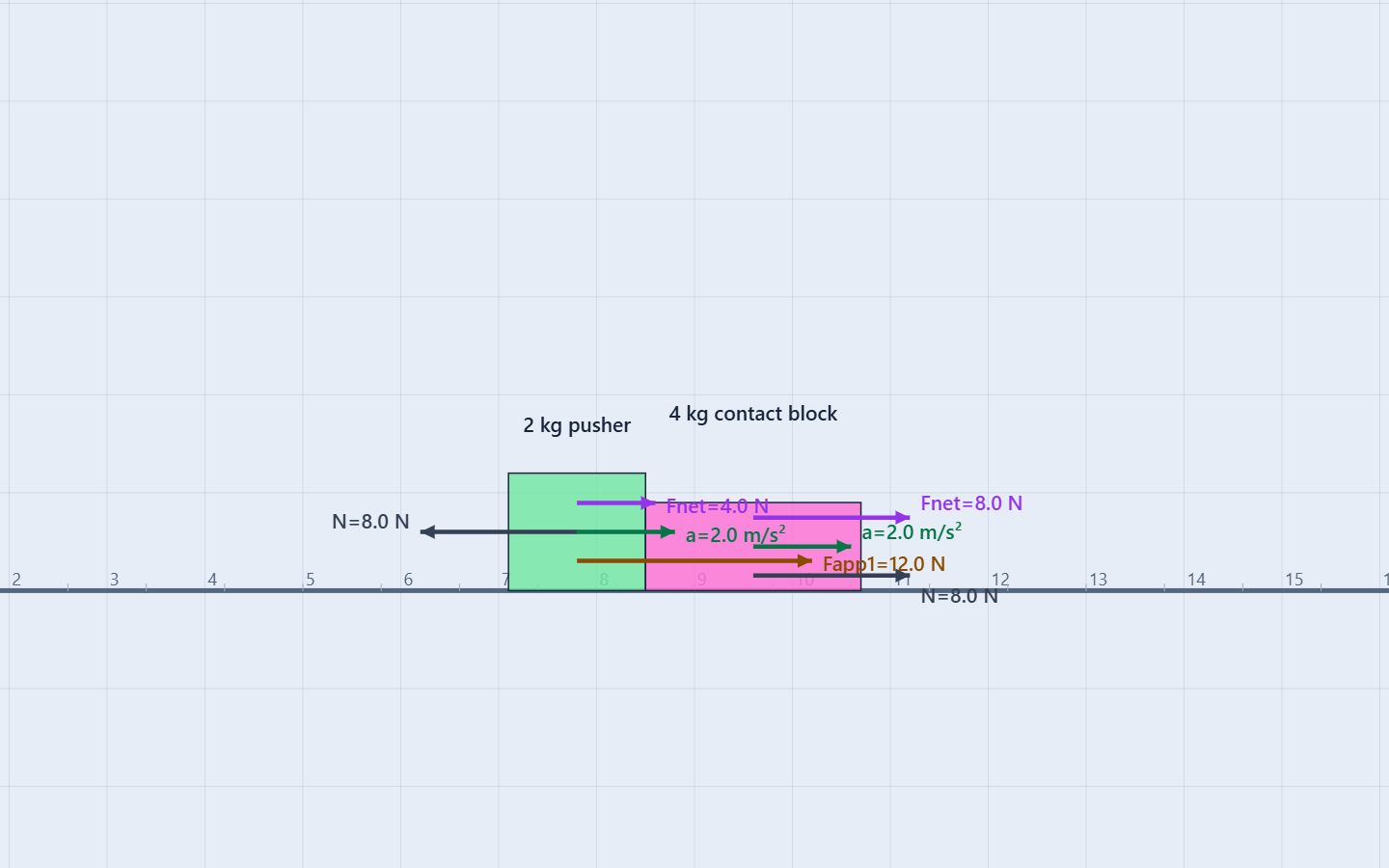
- Observe a third-law contact pair. A 12 N push on a 2 kg pusher and 4 kg block gives equal and opposite contact forces on different objects. Those arrows are not a balance on either individual object.
- Connect equal forces to unequal acceleration. A 2 kg exhaust packet and a 6 kg rocket can exert equal 12 N forces while accelerating at 6 m/s2 and 2 m/s2, respectively.
- Finish with the system-first strategy. Decide the system before canceling forces, applying components, selecting a friction model, or using a connected-motion constraint.
| Situation | What to identify first | Useful relationship | Prediction |
|---|---|---|---|
| Rest or constant velocity | Net force on the chosen object | ΣF⃗ = 0 | a⃗ = 0 |
| One accelerating object | External forces and axes | ΣF⃗ = m a⃗ | Acceleration follows net force |
| Atwood system | Rope constraint and boundary | |a1| = |a2| | Opposite directions, shared magnitude |
| Static friction | Attempted relative motion | 0 ≤ fs ≤ μsFN | Actual friction adjusts as needed |
| Third-law interaction | Source, target, and interaction type | F⃗A on B = −F⃗B on A | Equal forces on different objects |
Worked examples
Make the boundary and signs visible
For the 40 kg elevator rider accelerating upward at 3 m/s2:
FN − mg = may
FN = (40 kg)(9.8 m/s2) + (40 kg)(3 m/s2) = 512 N
For the 4 kg block on a frictionless 30° ramp:
Fparallel = mg sin30° = (4)(9.8)(0.5) = 19.6 N
aparallel = Fparallel/m = 4.9 m/s2 down the ramp
FN = mg cos30° ≈ 33.95 N
For the 4 kg block with a 24 N horizontal push on a level surface:
FN = mg = 39.2 N; fk = μkFN = (0.25)(39.2) = 9.8 N
ΣFx = 24 N − 9.8 N = 14.2 N; ax = 3.55 m/s2 right
For an ideal Atwood machine with 2 kg and 4 kg masses:
a = g(mheavy − mlight)/(mheavy + mlight)
a = 9.8(4 − 2)/(4 + 2) = 3.27 m/s2
System boundaries
Internal and external forces depend on what you select
A force is external when it crosses the boundary of the chosen system. It belongs in the system’s net-force sum. A force is internal when both objects that exchange it are inside the boundary. Internal forces cancel in the combined equation, even though each force still appears on a separate object’s free-body diagram.
| Chosen system | Forces to include | What the equation reveals |
|---|---|---|
| One block in contact | Contact force from the pusher, plus other forces on that block | That block’s acceleration and contact force |
| Both contact blocks | External push; contact pair is internal | Total acceleration of the combined mass |
| One Atwood mass | Weight and tension on that mass | Its acceleration and rope tension |
| Both Atwood masses | Weight difference; tension is internal | Shared acceleration constraint |
Special cases
Recognize the condition before selecting a model
Elevators: apparent weight is the normal force, not the gravitational force. Use the sign of acceleration in FN − mg = may.
Inclines: choose axes parallel and perpendicular to the ramp. The normal force balances the perpendicular component only when no other perpendicular force acts.
Friction: static friction adjusts up to μsFN; kinetic friction is μkFN after sliding starts. Both oppose relative motion at the contact.
Connected systems: a taut ideal rope supplies a motion constraint. Equal acceleration magnitudes do not mean equal net forces on the separate masses.
Third-law pairs: reverse the source and target of the same interaction. Do not pair weight with normal force just because the two arrows balance on one object.
Common misconceptions
Check the reasoning
Can I start with the equation I remember?
Start with the system and force diagram. The correct equation follows from the interactions and constraints in that situation.
Does equilibrium require the object to be at rest?
No. Dynamic equilibrium means zero net force and constant velocity. A moving crate can be in equilibrium.
Is normal force always equal to weight?
No. Acceleration, ramps, and angled pushes change the perpendicular force balance and therefore change FN.
Is static friction always μsFN?
No. That is the maximum possible value. Actual static friction is the amount required to prevent attempted relative motion.
Do equal and opposite forces cancel on one object?
Third-law partners act on different objects. They cancel in a combined-system equation only when both objects are inside the boundary.
Does equal force mean equal acceleration?
No. Use a = F/m separately for each object. Equal masses are required for equal acceleration magnitudes under equal net-force magnitudes.
Does zero scale reading mean gravity disappeared?
No. In free fall the normal force is zero while the gravitational force still provides the downward acceleration.
For teachers
Use the review as a decision-making lab
Require students to write the selected object or system at the top of every solution. Have them draw the free-body diagram, mark positive axes, and state the physical condition before they substitute numbers.
Run the guided lesson in order: balance and First Law, direct and inverse proportionality, dynamic equilibrium, apparent weight, Atwood constraints, ramp components, friction, and third-law pairs. Ask students to compare one changed variable at a time so each simulation result has a clear cause.
Continue with Free-Body Diagrams for force classification, Newton’s Second Law for proportional reasoning, Inclined Planes for components, Friction for contact models, and Newton’s Third Law for interaction pairs.