
Plan the investigation
Does horizontal motion change vertical fall?
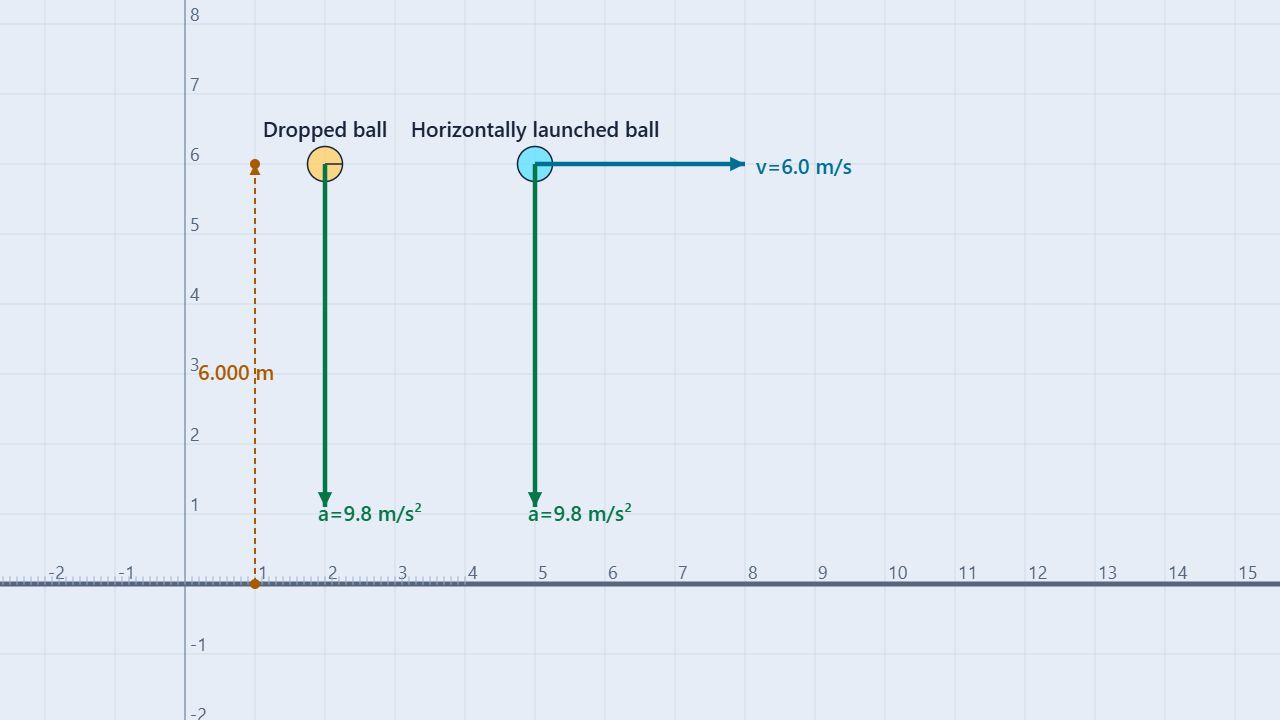
The prepared scene releases two 1.00 kg balls from the same height of about 6.00 m. The Dropped ball starts with vx = 0, while the Horizontally launched ball starts with vx = +6.00 m/s. Both begin with vy = 0 and experience the same gravity, ay = −9.80 m/s², with air resistance off.
Change or control
Change horizontal launch speed, release height, or gravitational field strength. Keep both objects at the same starting height and initial vertical velocity for the independence comparison.
Measure and compare
Record y, vy, landing time, and horizontal displacement. Compare the vertical rows first, then use x = x0 + vxt to explain the different ranges.
Use up as positive. The horizontal launch changes x and the shape of the path, but it does not add a vertical velocity component or change the ideal vertical acceleration.
Procedure
A useful five-trial workflow
- Load and identify. Launch the simulation and choose Projectile-Motion Independence. Select each ball in Objects and record its starting x, y, vx, and vy. Open Data → Graph; vertical position and vertical velocity are prepared for comparison.
- Predict the vertical rows. Because both balls start at the same height with the same vy, predict matching y and vy values at every time before either ball reaches the ground.
- Predict the horizontal separation. The dropped ball keeps x nearly constant. The launched ball’s horizontal displacement is Δx = vxt, so its horizontal separation should grow linearly while the vertical data still match.
- Run and analyze. Run for about 0.8 s, compare the two trails and vertical vectors, then inspect y–t and vy–t one graph at a time. The y–t curves should overlap, and the vy–t lines should overlap with slope −9.80 m/s².
- Change one condition and repeat. Reset before changing only horizontal speed, release height, or gravity. Record landing times and horizontal ranges, then use Export CSV for the synchronized histories.
| t (s) | Δy for both (m) | vy for both (m/s) | Dropped Δx (m) | Launched Δx (m) |
|---|---|---|---|---|
| 0.00 | 0.00 | 0.00 | 0.00 | 0.00 |
| 0.25 | −0.31 | −2.45 | 0.00 | +1.50 |
| 0.50 | −1.23 | −4.90 | 0.00 | +3.00 |
| 0.75 | −2.76 | −7.35 | 0.00 | +4.50 |
| 1.00 | −4.90 | −9.80 | 0.00 | +6.00 |
For a 6.00 m drop, ideal landing occurs at t = √(2h/g) ≈ 1.11 s. Both balls have the same landing time and vertical impact speed, while the launched ball has traveled about 6.64 m horizontally.
Worked comparison
Separate fall time from horizontal range
Use h = 6.00 m, viy = 0, and g = 9.80 m/s².
tflight = √(2h/g) = √(12.00/9.80) = 1.11 s
vfy = −gt = −9.80(1.11) ≈ −10.84 m/s
Launched-ball range = vxt = 6.00(1.11) ≈ 6.64 m
The dropped ball has the same flight time and vertical impact speed but nearly zero horizontal range. Horizontal velocity determines how far the ball travels while it falls; it does not determine how long the fall takes.
Expected data pattern
Look for matching vertical histories
These rounded values show the pattern before contact. Your Data rows contain absolute positions, so subtract each ball’s starting position when comparing vertical displacement.
| t (s) | Dropped y change (m) | Launched y change (m) | Dropped vy (m/s) | Launched vy (m/s) |
|---|---|---|---|---|
| 0.00 | 0.00 | 0.00 | 0.00 | 0.00 |
| 0.25 | −0.31 | −0.31 | −2.45 | −2.45 |
| 0.50 | −1.23 | −1.23 | −4.90 | −4.90 |
| 0.75 | −2.76 | −2.76 | −7.35 | −7.35 |
| 1.00 | −4.90 | −4.90 | −9.80 | −9.80 |
Overlapping y and vy graphs are the evidence for independent horizontal and vertical motion. The x graph separates the objects because their horizontal velocities differ.
Common misconception
What does horizontal launch speed actually change?
It changes horizontal position and range. In the ideal model, it does not change vertical position, vertical velocity, vertical acceleration, or time to fall from the same height.
Does the faster projectile fall faster?
No. If the starting height and initial vertical velocity match, both objects have the same vertical acceleration and land together.
Does the longer path take longer?
No. The launched ball follows a longer diagonal path, but its vertical fall time is set by the vertical motion.
Does a heavier ball land later?
No, when air resistance is ignored. A mass comparison changes the weight force but not the ideal gravitational acceleration.
For teachers
Build from one-dimensional free fall to projectiles
Ask students to write separate horizontal and vertical equations before running. Require them to identify which quantities match and which quantities differ, rather than describing the launched ball only as “faster.”
Extend the experiment by doubling the horizontal launch speed and measuring the range. Then quadruple the release height: flight time doubles, so the horizontal range also doubles when vx stays fixed. A mass comparison provides a clean test of the no-air-resistance model.
The Free Fall lab isolates the vertical model, while the Projectile Motion lab adds vertical launch velocity. Reference guides: Projectile Motion, Free Fall Motion, and 2D Vectors and Relative Motion.